What is Fiscal Deficit? Meaning, Formula, Causes & Impact on Your Money
Quick Summary (Key Takeaways):
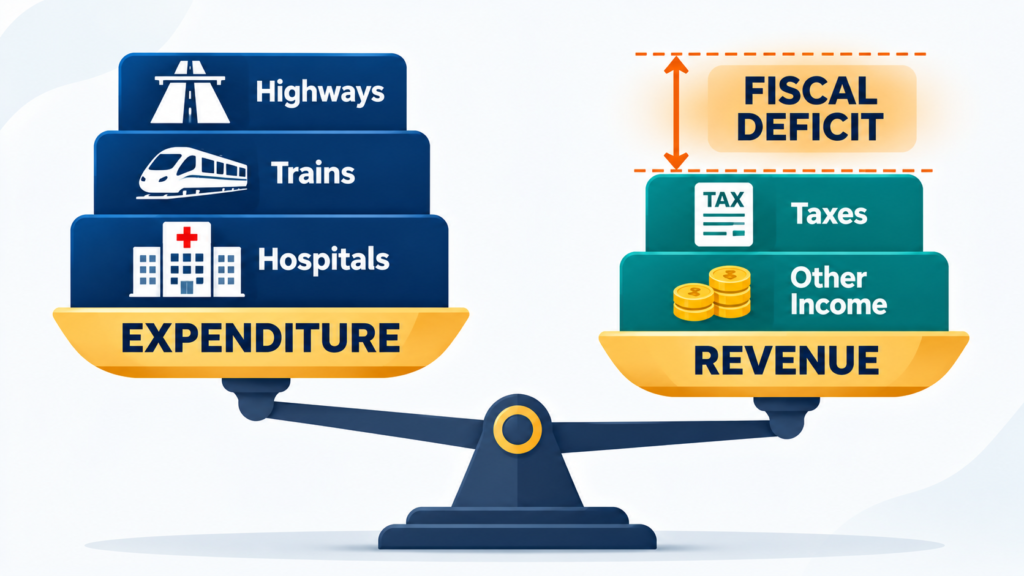
- Meaning: A fiscal deficit occurs when a government’s total expenditure exceeds its total revenue (excluding borrowings) in a financial year. It represents the exact amount the government must borrow to meet its spending commitments.
- Formula: \(\text{Fiscal Deficit} = \text{Total Expenditure} – (\text{Revenue Receipts} + \text{Non-Debt Capital Receipts})\)
- India’s Current Target: After meeting its 4.4% of GDP target in FY 2025–26, India has targeted a fiscal deficit of 4.3% of GDP (₹16.96 lakh crore) for FY 2026–27, shifting toward a long-term debt-to-GDP anchor of 50±1% by 2030–31. [1, 2, 3]
- What is Fiscal Deficit? (Explained Simply)
In public finance, “fiscal” refers to government revenue and spending, while “deficit” means a shortfall. Put together, a fiscal deficit is the gap between how much money a government spends and how much it earns in a single financial year—without counting borrowed money as income. [1, 2]
The Household Budget Analogy
Imagine your household earns ₹10 lakh in a year from salaries and dividends, but you spend ₹12 lakh on daily groceries, utility bills, and building a new room. You have a shortfall of ₹2 lakh. To cover that gap, you take a loan.
In government terms, that ₹2 lakh borrowing requirement is your fiscal deficit. Economists express this gap as a percentage of Gross Domestic Product (GDP) to measure whether a country’s borrowing is manageable relative to the size of its economy.
Important Distinction: Fiscal Deficit is not the same as National Debt (Fiscal Debt). A fiscal deficit is a single year’s borrowing shortfall, whereas national debt is the total accumulated debt built up over decades of annual deficits.
- Fiscal Deficit Formula & Step-by-Step Calculation
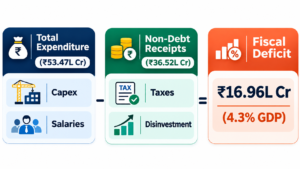
To calculate a country’s fiscal deficit accurately, you must separate non-debt receipts (money the government actually earns) from debt receipts (loans taken to bridge the gap). [1, 2]
The Standard Formula
\(\text{Fiscal\ Deficit}=\text{Total\ Expenditure}-\text{Total\ Receipts\ (excluding\ borrowings)}\)
The Expanded Formula
\(\text{Fiscal\ Deficit}=(\text{Revenue\ Expenditure}+\text{Capital\ Expenditure})-(\text{Revenue\ Receipts}+\text{Non-Debt\ Capital\ Receipts})\)
Breaking Down the Components:
- Revenue Expenditure: Day-to-day operational costs that do not create physical assets—such as government salaries, pensions, subsidies, defence upkeep, and interest payments on past loans. [1, 2]
- Capital Expenditure (Capex): Long-term investments that build productive assets—such as highways, railways, ports, power grids, and public hospitals. [1, 2]
- Revenue Receipts: Routine income from Tax Revenue (Income Tax, Corporate Tax, GST, Customs) and Non-Tax Revenue (dividends from PSUs and the RBI, spectrum fees, interest receipts). [1, 2]
- Non-Debt Capital Receipts: Money raised without creating debt—primarily disinvestment (selling government stakes in PSUs) and recovery of past loans given to states or public enterprises. [1, 2]
Step-by-Step Worked Example (Union Budget 2026–27 Estimates)
Here is how the formula works using India’s FY 2026–27 Budget Estimates: [1, 2]
| Budget Component | FY 2026–27 Estimate (₹ Lakh Crore) | Category |
| A. Revenue Expenditure (Salaries, interest, subsidies, grants) | ₹41.25 | Routine Spending |
| B. Capital Expenditure (Infrastructure & asset creation) | ₹12.22 | Asset Creation |
| 1. Total Expenditure (A + B) | ₹53.47 | Total Outflow |
| C. Net Tax & Non-Tax Revenue Receipts | ₹35.33 | Routine Income |
| D. Non-Debt Capital Receipts (Disinvestment & loan recoveries) | ₹1.19 | Non-Debt Inflow |
| 2. Total Non-Debt Receipts (C + D) | ₹36.52 | Total Inflow |
| Fiscal Deficit (1 − 2) | ₹16.96 lakh crore | 4.3% of GDP |
(Source: Union Budget 2026–27 Highlights, PIB & PRS India Budget Analysis)
- Fiscal Deficit vs. Revenue, Primary & Effective Revenue Deficit
Economists track four distinct deficit indicators to judge whether a government is borrowing responsibly or falling into a debt trap: [1, 2]
| Metric | Formula | What It Measures | FY 2026–27 Target (% of GDP) |
| Fiscal Deficit | \(\text{Total Expenditure} – \text{Non-Debt Receipts}\) | Total borrowing requirement of the government for the year. | 4.3% |
| Revenue Deficit | \(\text{Revenue Expenditure} – \text{Revenue Receipts}\) | Whether routine tax/non-tax income covers day-to-day running costs. | 1.5% |
| Primary Deficit | \(\text{Fiscal Deficit} – \text{Interest Payments}\) | How much borrowing is needed for current spending, excluding old loan interest. | 0.7% |
| Effective Revenue Deficit | \(\text{Revenue Deficit} – \text{Grants for Capital Assets}\) | True consumption shortfall after excluding grants given to states to build assets. | 0.3% |
- Quality of Fiscal Deficit: When is a Deficit Actually Good?
A fiscal deficit is not automatically bad. Almost every major economy—including the U.S., India, the UK, and Japan—runs a fiscal deficit. What matters most to economists and global rating agencies is the quality of the deficit. [1, 2]
- Good Deficit (Capex-Driven)
When borrowed money is spent on Capital Expenditure (roads, freight corridors, digital infrastructure, clean energy), it creates jobs, lowers logistics costs, and boosts future GDP growth. That higher growth generates more tax revenue later, allowing the government to repay the debt easily. This triggers “Crowding In,” where public infrastructure encourages private companies to invest alongside the government.
- Bad Deficit (Revenue-Driven)
When a large share of borrowed money goes toward Revenue Deficit (populist freebies, untargeted subsidies, or paying interest on old loans), no productive assets are created. Worse, heavy government borrowing absorbs available bank liquidity, pushing up interest rates and starving private businesses of affordable credit—a problem known as “Crowding Out”. [1, 2, 3]
- How Does the Government Finance a Fiscal Deficit?
When expenditure exceeds non-debt income, the government bridges the gap through four main channels: [1, 2]
- Domestic Market Borrowings (Largest Source): The Reserve Bank of India (RBI) auctions Government Securities (G-Secs) and Treasury Bills (T-Bills) to banks, insurance companies, mutual funds, and retail investors. In FY 2026–27, net market borrowings are budgeted at ₹11.7 lakh crore.
- National Small Savings Fund (NSSF): Money deposited by citizens into Post Office schemes, Public Provident Fund (PPF), and National Savings Certificates (NSC) is borrowed by the central government.
- External Borrowings: Low-interest, long-tenure loans from multilateral agencies like the World Bank, Asian Development Bank (ADB), or bilateral sovereign partners. (India keeps external debt low to protect against currency fluctuations).
- Deficit Monetisation (Last Resort): Printing new currency by having the central bank directly buy government bonds. Modern economies avoid this because it rapidly increases money supply and sparks severe inflation. [1, 2, 3, 4]
- India’s Fiscal Deficit Trend & FRBM Roadmap (2003–2031)
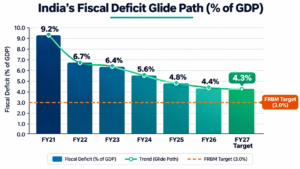
To prevent reckless government spending, Parliament passed the Fiscal Responsibility and Budget Management (FRBM) Act in 2003, originally aiming to cap the fiscal deficit at 3% of GDP. While crises forced temporary pauses, India has maintained a strict post-pandemic consolidation glide path: [1, 2, 3]
- FY 2007–08 (Pre-Global Financial Crisis): Dropped to a historic low of 2.5% of GDP amid booming tax collections.
- FY 2020–21 (COVID-19 Peak): Surged to 9.2% of GDP as tax revenues collapsed and emergency healthcare and food relief spending spiked.
- FY 2023–24: Narrowed to 5.6% of GDP.
- FY 2024–25: Reduced to 4.8% of GDP.
- FY 2025–26: Achieved 4.4% of GDP, fulfilling the government’s landmark pledge to bring the deficit below 4.5%.
- FY 2026–27 & Beyond: Targeted at 4.3% of GDP. Starting FY 2026–27, the Ministry of Finance has shifted its primary fiscal anchor from a rigid annual deficit number to reducing Central Government Debt-to-GDP from 56.1% (FY26) to 50±1% by March 2031. [1, 2, 3, 4, 5, 6, 7, 8, 9, 10]
- How Fiscal Deficit Affects Your Loans, Inflation & Investments
Even if you do not follow Union Budget speeches, the fiscal deficit directly affects your household finances: [1]
- Home & Car Loan EMIs: When the government borrows heavily from the bond market, bond yields rise. Since banks benchmark their lending rates to government bond yields and RBI policy rates, a high fiscal deficit keeps home, auto, and business loan interest rates elevated.
- Inflation & Purchasing Power: Excess government spending puts more money into circulation. If supply does not keep up, prices of everyday goods rise, reducing your real purchasing power.
- Stock & Bond Market Returns: A shrinking fiscal deficit (like India’s drop from 9.2% to 4.3%) signals macroeconomic stability. This encourages foreign institutional investors (FIIs), strengthens the Indian Rupee, and boosts sovereign credit ratings—benefiting both equity investors and long-term debt mutual fund holders. [1, 2, 3]
- Frequently Asked Questions (FAQs)
What is fiscal deficit in simple words?
Fiscal deficit is the shortfall when a government’s total spending in a year is higher than its total income from taxes and other non-loan sources. The government covers this difference by borrowing money. [1]
What is India’s fiscal deficit target for 2026–27?
In the Union Budget 2026–27, the Government of India set the fiscal deficit target at 4.3% of GDP (approximately ₹16.96 lakh crore), down from 4.4% of GDP in FY 2025–26. [1, 2]
What is the difference between fiscal deficit and budget deficit?
In modern budgeting, budget deficit refers to total expenditure minus total receipts including borrowings (which technically nets to zero once loans are accounted for). Fiscal deficit excludes borrowings from receipts, making it the true measure of a government’s total borrowing requirement. [1]
What happens if a country’s fiscal deficit is zero?
A zero fiscal deficit means the government has a balanced budget—it spends exact parity with what it earns without borrowing a single rupee. While debt-free, running a zero deficit in a developing economy like India would severely restrict funding for highways, railways, defence, and welfare schemes.