What Is GDP (Gross Domestic Product)? Meaning, Formula, and Types
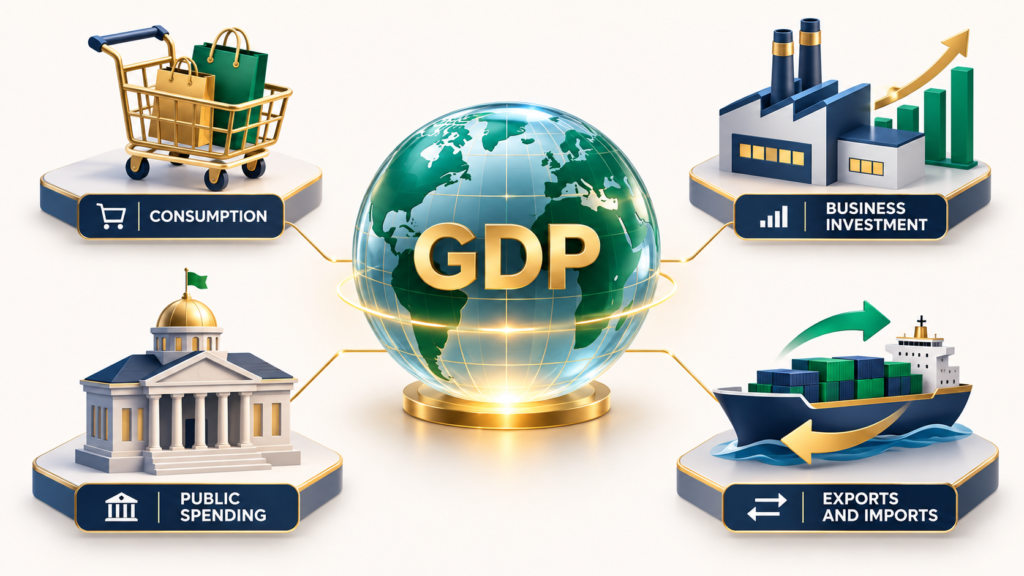
Gross Domestic Product (GDP) is the total monetary value of all finished goods and services produced within a country’s borders during a specific period, typically a quarter or a year. Economists, central banks, and investors use GDP as the primary scorecard to measure an economy’s size, health, and growth rate.
Key Takeaways
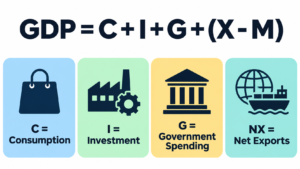
- Core Formula: Calculated primarily via spending using GDP = C + I + G + NX (Consumption + Investment + Government Spending + Net Exports).
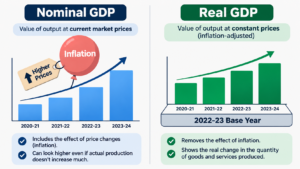
- Best Growth Metric: Real GDP adjusts for inflation, making it more accurate than Nominal GDP for tracking true economic growth.
- Recession Signal: Two consecutive quarters of negative real GDP growth is widely used as a rule-of-thumb indicator of a recession.
- Main Blind Spots: GDP does not measure income inequality, unpaid household work, environmental damage, or the informal cash economy.
How Does GDP Work? (Simple Explanation)
Think of GDP as a massive receipt for everything newly made and sold inside a country.
If a bakery buys flour for $2 and sells a loaf of bread for $5, GDP only counts the $5 final price—not the $2 flour. Excluding intermediate raw materials prevents double-counting and ensures GDP reflects true final output.
What Are the 3 Ways to Calculate GDP?
Economists calculate GDP using three different methods. In theory, all three approaches arrive at the exact same number because one person’s spending is another person’s income.
- The Expenditure Approach (Most Common)
This method adds up all money spent on final goods and services by households, businesses, the government, and foreign buyers.
\(\text{GDP}=C+I+G+(X-M)\)
- Consumption (C): Household spending on groceries, rent, healthcare, electronics, and services (typically 60%–70% of a developed economy).
- Investment (I): Business spending on machinery, factories, software, new housing construction, and unsold inventory.
- Government Spending (G): Public spending on infrastructure, defense, public schools, and civil servant salaries (excludes transfer payments like Social Security or unemployment benefits).
- Net Exports (X – M): Total exports (X) minus total imports (M). A trade surplus boosts GDP; a trade deficit lowers it.
- The Income Approach
This method totals all income earned by individuals and businesses producing goods and services within the country:
- Formula: GDP = Wages + Rent + Interest + Corporate Profits + Net Indirect Taxes + Depreciation
- The Production (Value-Added) Approach
This method calculates the gross value of economic output across all industries (agriculture, manufacturing, services) and subtracts the cost of intermediate goods consumed during production.
Step-by-Step GDP Calculation Example
Imagine a simple economy that only produces smartphones in a given year:
- A mining company extracts raw lithium and sells it to a chipmaker for $100.
- The chipmaker builds processors and sells them to a phone manufacturer for $300.
- The manufacturer assembles the phones and sells them to consumers for $800.
- Using the Expenditure Method: Consumers spent $800 on the final product. GDP = $800.
- Using the Value-Added Method: Mining ($100) + Chipmaker ($300 − $100 = $200) + Manufacturer ($800 − $300 = $500) = $800.
What Are the Main Types of GDP?
| GDP Type | What It Measures | Best Used For |
| Nominal GDP | Total output valued at current market prices (includes inflation). | Comparing the current size of different economies in the same year. |
| Real GDP | Total output adjusted for inflation using a constant base-year price. | Measuring true economic growth from one year or quarter to the next. |
| GDP Per Capita | Total GDP divided by the country’s total population. | Estimating average individual income and standard of living. |
| GDP Growth Rate | The percentage change in Real GDP from one period to the next. | Identifying economic booms, slowdowns, or recessions. |
| GDP (PPP) | GDP adjusted for Purchasing Power Parity (local cost of living). | Comparing living standards accurately between countries with different currencies. |
GDP vs. GNP vs. GNI: What Is the Difference?
While GDP focuses on location (inside a country’s borders), GNP and GNI focus on ownership and citizenship.
| Metric | Full Form | Focus Area | Example |
| GDP | Gross Domestic Product | Production inside a country’s borders, regardless of company nationality. | A Japanese car factory operating in the U.S. counts toward U.S. GDP. |
| GNP | Gross National Product | Production by a country’s citizens/companies, anywhere in the world. | Profits from that Japanese factory count toward Japan’s GNP. |
| GNI | Gross National Income | Total income earned by a nation’s residents and businesses domestically and abroad. | Used by the World Bank to classify countries by income level. |
How Does GDP Affect Everyday People?
GDP isn’t just a number for Wall Street—it directly shapes your personal finances:
- Interest Rates & Loans: When GDP grows too fast, inflation often rises. Central banks (like the Federal Reserve or RBI) respond by raising interest rates, making mortgages, car loans, and credit cards more expensive.
- Job Security & Wages: Rising GDP signals businesses are expanding and hiring, giving workers stronger leverage for raises. Shrinking GDP leads to hiring freezes and layoffs.
- Stock Market Returns: Corporate earnings track closely with GDP growth. Sustained contractions often trigger bear markets, while steady 2%–3% real growth supports long-term equity gains.
What Are the Limitations of GDP?
GDP measures market activity, not human well-being. Economists highlight several major blind spots:
- Ignores Unpaid Work: Childcare, eldercare, volunteering, and home cooking add massive societal value but generate $0 in GDP.
- Overlooks Inequality: A country’s GDP can surge while the median worker’s wages stagnate if gains flow only to the top 1%.
- Counts Environmental Damage as Growth: Clearing a forest for timber or spending billions on disaster cleanup increases GDP, even though natural wealth is destroyed.
- Misses the Digital & Informal Economy: Free digital tools (search engines, open-source software, AI tools) boost productivity without direct consumer prices, while cash-based informal work goes unrecorded.
Frequently Asked Questions (FAQs)
What is a good GDP growth rate?
For developed economies (like the U.S., UK, or EU), a healthy, sustainable real GDP growth rate is typically 2% to 3% per year. Developing economies (like India) often target 6% to 8% to create enough jobs for a growing workforce.
What happens when GDP is negative?
Negative GDP growth means the economy is shrinking—businesses are producing less, and consumers are spending less. If real GDP declines for two consecutive quarters, economists generally consider the economy to be in a technical recession.
Why is Real GDP better than Nominal GDP?
Real GDP removes the distortion of rising prices (inflation). If an economy produces the exact same number of goods as last year, but prices rise by 10%, Nominal GDP will appear to grow by 10%, whereas Real GDP will accurately show 0% real growth.