What Is a Recession? Meaning, Causes, Warning Signs, and How to Prepare
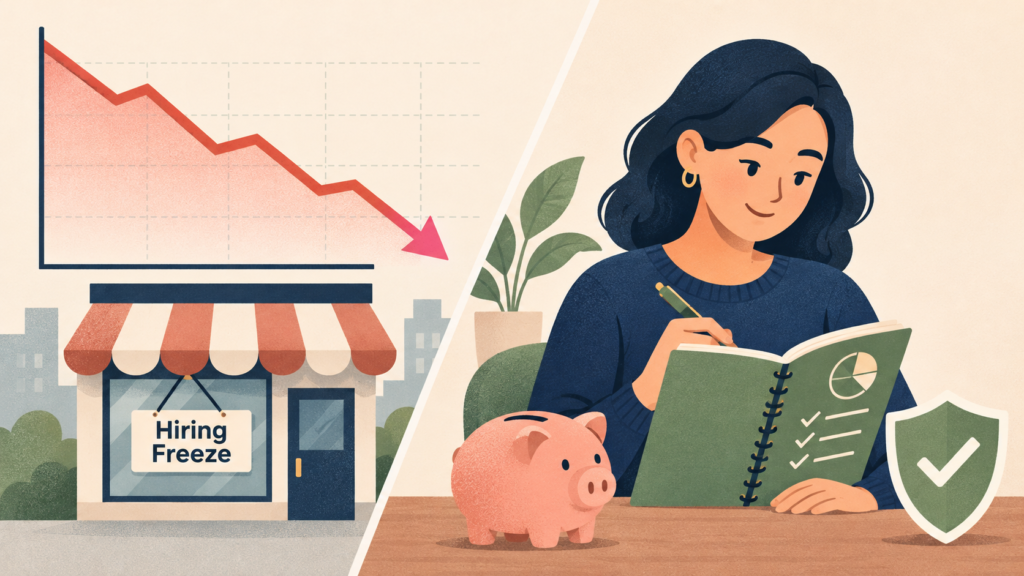
A recession is a significant, widespread decline in economic activity that lasts for several months or more. During a recession, businesses earn less revenue, consumer spending slows down, overall economic output shrinks, and unemployment rises.
While economists often use two consecutive quarters of negative Gross Domestic Product (GDP) growth as a quick rule of thumb, official economic bodies look at a broader mix of data—including job losses, household income, industrial production, and retail sales—before declaring a recession.
Technical Recession vs. Official Recession: What’s the Difference?
Not every economic slowdown is officially labeled a recession, and not every recession looks the same on paper. Understanding how economists measure downturns explains why headlines and everyday reality sometimes disagree.
- The Two-Quarter Rule (Technical Recession): Many countries—including the UK and the European Union—use two back-to-back quarters (six months) of shrinking real GDP as the standard benchmark for a technical recession.
- The Broader Indicator Approach (Official Recession): In the United States, the National Bureau of Economic Research (NBER) does not rely solely on GDP. Instead, it evaluates whether a downturn is deep, widespread, and lasting across employment, real personal income, industrial output, and wholesale-retail sales.
- Why This Matters (“Vibecessions”): An economy can experience two quarters of slightly negative GDP while unemployment stays low—or conversely, GDP can grow on paper while high living costs make everyday households feel squeezed.
Recession vs. Depression vs. Stagflation vs. Inflation
Economic terms are frequently confused in financial news. Use this quick comparison matrix to see how a recession differs from other major economic conditions:
| Economic Term | What Happens to GDP? | What Happens to Prices? | What Happens to Jobs? | Typical Duration |
| Recession | Shrinks moderately for months | Usually slows down or dips | Unemployment rises noticeably | 6 to 18 months |
| Depression | Collapses severely (often >10%) | Drops sharply (deflation) | Mass unemployment (15%–25%+) | Several years |
| Inflation | Usually growing | Rises rapidly across goods/services | Employment is often strong | Varies (months to years) |
| Stagflation | Stagnant or shrinking | Rises rapidly despite weak growth | High unemployment | Years (difficult to fix) |
What Causes a Recession? (The Domino Effect)
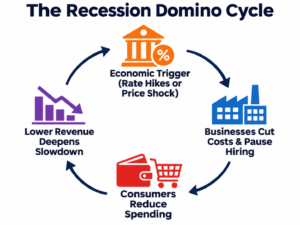
Recessions rarely have a single trigger. Instead, an initial shock sets off a chain reaction—or domino effect—across businesses, lenders, and households:
- The Initial Trigger: An unexpected shock hits the economy. Common triggers include:
- Aggressive Interest Rate Hikes: Central banks (like the Federal Reserve or Reserve Bank of India) raise rates to tame high inflation, making loans and mortgages more expensive.
- Supply Shocks: Sudden spikes in essential costs—such as crude oil, energy, or raw materials—squeeze business profit margins.
- Bursting Asset Bubbles: Overvalued markets (such as housing in 2008 or dot-com stocks in 2000) crash, wiping out household and corporate wealth.
- Excessive Debt: When consumers and companies borrow too heavily during boom times, rising defaults can freeze credit markets.
- Businesses Pull Back: Facing lower sales or higher borrowing costs, companies pause expansion, cut budgets, and institute hiring freezes or layoffs.
- Consumers Cut Spending: Rising layoffs and economic uncertainty cause families to delay big purchases (cars, homes, travel) and focus on saving cash.
- The Feedback Loop: Because one person’s spending is another person’s income, reduced household spending lowers business revenue further—deepening the contraction until policy changes or lower prices spark a recovery.
How to Spot a Recession Early: Wall Street vs. Main Street Signs
Because official recession announcements are usually made months after a downturn has already begun, economists and everyday workers watch early warning signs.
| Indicator Type | Wall Street / Macro Signals | Main Street / Everyday Signals |
| Jobs & Income | The Sahm Rule: The 3-month average unemployment rate rises 0.50% or more above its 12-month low. | Hiring freezes in your industry, fewer recruiter messages, and smaller annual bonuses. |
| Credit & Rates | Inverted Yield Curve: Short-term government bonds pay higher interest than 10-year bonds. | Banks tighten credit card limits and require higher credit scores for personal or home loans. |
| Consumer Behavior | Falling retail sales and declining consumer confidence survey scores. | Households “trading down” to generic store brands, dining out less, and delaying vacations. |
| Business Activity | Falling manufacturing orders and declining freight/shipping volumes. | Local storefronts closing, heavier retail discounting, and companies cutting freelance budgets. |
How Long Do Recessions Last? (Historical Comparison)
Recessions are a normal part of the business cycle, and modern recessions have generally become shorter due to faster central bank and government responses.
| Historical Event | Duration | Peak U.S. Unemployment | Key Trigger |
| The Great Depression (1929–1939) | ~43 months (initial contraction) | ~24.9% | Stock market crash, bank failures, policy mistakes |
| Early 1980s Recession (1981–1982) | 16 months | 10.8% | Aggressive interest rate hikes to crush 1970s inflation |
| The Great Recession (2007–2009) | 18 months | 10.0% | Subprime mortgage crisis and global banking collapse |
| COVID-19 Recession (2020) | 2 months | 14.8% | Global lockdowns and sudden halt in travel/service spending |
Note: Even after a recession officially ends—meaning the economy stops shrinking and begins growing again—it often takes another one to three years for the job market and household incomes to fully recover.
How a Recession Affects Your Wallet
A downturn impacts every corner of personal finance differently:
- Jobs and Wages: Layoffs rise, particularly in cyclical industries like tech, construction, hospitality, and luxury retail. Even workers who keep their jobs often experience slower salary growth.
- Interest Rates and Loans: To revive the economy, central banks typically cut benchmark interest rates during a recession. While this eventually makes home loans and refinancing cheaper, banks simultaneously become stricter about approving borrowers with lower credit scores.
- Savings Accounts: Lower central bank interest rates mean banks gradually reduce the interest rates paid on high-yield savings accounts and fixed deposits/CDs.
- Stock Market and Retirement Funds: Stock prices frequently fall before a recession is officially declared and often begin recovering before the recession ends. Selling investments during a downturn locks in temporary losses.
- Silver Linings: For financially stable households, recessions often bring lower inflation, discounted asset prices for long-term investors, and lower mortgage rates for refinancing existing debt.
The Recession Survival Playbook (By Role)
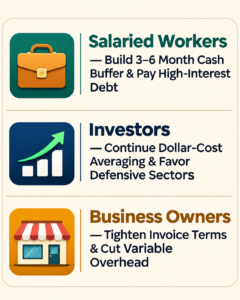
Preparing for an economic downturn does not require panic—it requires building a financial buffer tailored to your situation.
- For Salaried Employees
- Build a 3-to-6-Month Cash Buffer: Keep essential living expenses (rent/mortgage, groceries, utilities, insurance) in a liquid, accessible savings account.
- Audit High-Interest Debt: Prioritize paying down high-interest credit card balances so fixed monthly obligations stay manageable if income dips.
- Update Your Career Proof: Keep an updated resume, document measurable wins at work, and maintain industry connections before layoffs are announced.
- For Long-Term Investors
- Keep Investing Consistently: Use dollar-cost averaging (or automated monthly SIPs) to buy quality index funds or stocks at discounted valuations during market dips.
- Check Company Debt Levels: Avoid companies with heavy debt loads and weak cash flow, as they struggle most when credit tightens.
- Focus on Defensive Sectors: Essential industries—such as healthcare, utilities, and consumer staples (food and household goods)—historically experience steadier demand than luxury or travel stocks.
- For Small Business Owners & Freelancers
- Protect Cash Flow: Tighten invoice payment terms (e.g., Net 15 instead of Net 30) and follow up promptly on overdue receivables.
- Trim Variable Overhead: Audit software subscriptions, discretionary marketing spend, and inventory levels before revenue slows.
- Double Down on Core Clients: Retaining existing customers is far cheaper and more reliable during a downturn than acquiring new ones.
Frequently Asked Questions (FAQs)
What is the simple definition of a recession?
A recession is a period of several months or more when a country’s economy shrinks, leading to lower business profits, reduced consumer spending, and higher unemployment.
What happens to my money in the bank during a recession?
Your bank deposits remain safe up to standard government deposit insurance limits (such as FDIC in the U.S. or DICGC in India). However, the interest rate you earn on savings accounts may drop if the central bank cuts interest rates to stimulate the economy.
Which industries are most recession-resistant?
Industries that provide everyday necessities tend to hold up best during recessions. These include healthcare, grocery stores, consumer staples (soap, toothpaste, basic food), utilities (electricity, water), and discount retailers.
How does a recession end?
A recession ends when the economy hits its lowest point (the “trough”) and begins expanding again. This recovery is usually driven by central bank interest rate cuts, government stimulus spending, lower prices attracting buyers back, and businesses restocking inventory.