What Is Inflation? Meaning, Causes, Types, Formula, and How to Protect Your Money
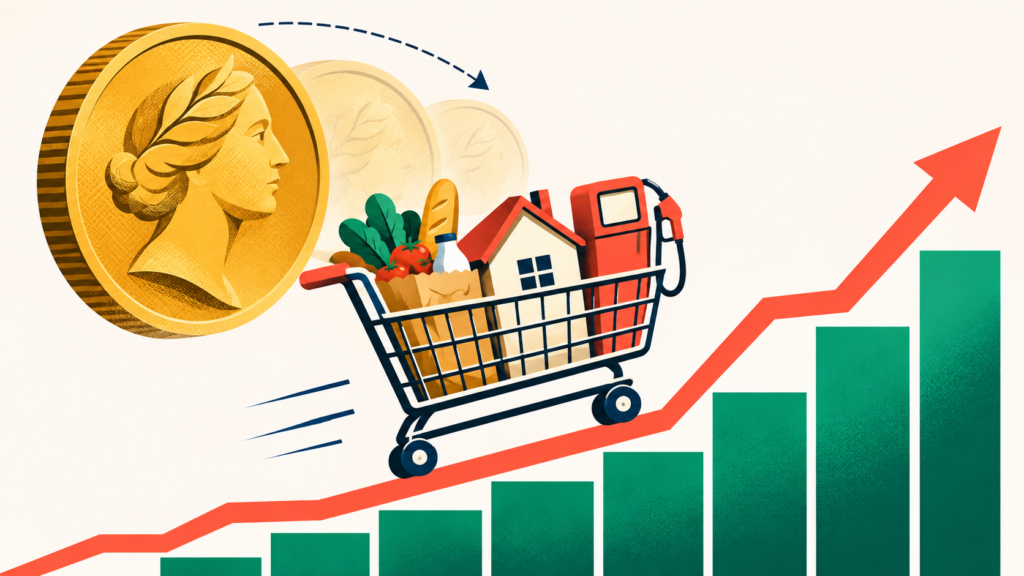
Inflation is a sustained increase in the general price level of goods and services in an economy over time, which reduces the purchasing power of money. When inflation rises, each rupee or dollar in your wallet buys fewer groceries, fuel, and everyday essentials than it did a year ago.
Think back to ten years ago: a family grocery run or a cup of restaurant coffee cost noticeably less than it does today. The items themselves did not necessarily improve in quality—instead, the value of currency gradually eroded.
While central banks view a small, predictable dose of inflation as a sign of a growing economy, rapid or unchecked inflation quietly drains household savings. This guide breaks down the exact meaning of inflation, how governments calculate it, why prices rise, and practical ways to keep your wealth ahead of rising costs.
How Does Inflation Work? (The Shopping Basket & Formula)
Economists do not measure inflation by tracking a single item like milk or petrol. Instead, statistical agencies track a representative “basket of goods and services” that an average household buys throughout the year.
This basket typically includes:
- Everyday essentials: Food, beverages, fuel, and electricity.
- Durable goods: Clothing, appliances, smartphones, and vehicles.
- Services: Rent, healthcare, education, transportation, and insurance.
Because households spend a much larger share of their income on housing, food, and energy than on items like salt or postage stamps, each category is assigned a weight based on consumer spending surveys. A 10% jump in fuel or food prices pushes overall inflation far higher than a 10% jump in movie tickets.
The Inflation Rate Formula
Governments convert the total cost of this weighted basket into a Consumer Price Index (CPI), setting a base year equal to 100. The annual inflation rate is simply the percentage change in that index from one year to the next:
\(\text{Inflation\ Rate}=\left(\frac{\text{CPI}_{\text{Current\ Year}}-\text{CPI}_{\text{Previous\ Year}}}{\text{CPI}_{\text{Previous\ Year}}}\right)\times 100\)
Example Calculation:
Suppose the CPI basket costs 120 this year compared to 112.5 last year:
\(\text{Inflation\ Rate}=\left(\frac{120-112.5}{112.5}\right)\times 100=6.67\%\)
How Fast Does Inflation Erode Your Purchasing Power?
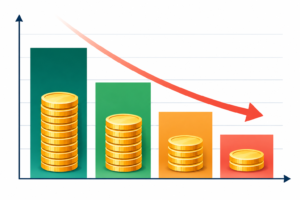
Even seemingly mild annual inflation compounds over time—working like a treadmill moving backward beneath your savings. You can estimate how many years it takes for prices to double using the Rule of 72 (divide 72 by the annual inflation rate).
| Annual Inflation Rate | Years for Prices to Double (Rule of 72) | Real Value of ₹1,00,000 After 10 Years | Real Value of ₹1,00,000 After 20 Years |
| 2% (Developed Economy Target) | 36.0 years | ₹82,035 | ₹67,297 |
| 4% (RBI Medium-Term Target) | 18.0 years | ₹67,556 | ₹45,639 |
| 6% (Moderate Emerging Market) | 12.0 years | ₹55,839 | ₹31,180 |
| 8% (Elevated Inflation) | 9.0 years | ₹46,319 | ₹21,455 |
Note: The same percentage decay applies to any currency (e.g., $100,000 drops to $55,839 in real purchasing power over 10 years at 6% inflation).
What Are the Main Causes of Inflation?
Economists classify the root drivers of rising prices into three primary mechanisms, alongside modern structural shocks.
- Demand-Pull Inflation (“Too Much Money Chasing Too Few Goods”)
Demand-pull inflation happens when overall consumer, business, and government demand grows faster than the economy’s ability to produce goods and services.
- Triggers: Economic booms, low interest rates that encourage cheap borrowing, tax cuts, or large government stimulus packages.
- Example: When travel and dining surged after pandemic lockdowns lifted, airlines and hotels raised prices rapidly because demand outstripped available seats and rooms.
- Cost-Push Inflation (Rising Production Costs)
Cost-push inflation occurs when the supply of goods shrinks or becomes more expensive to produce, forcing businesses to pass higher input costs onto consumers to protect their margins.
- Triggers: Surges in crude oil and energy prices, raw material shortages, supply chain bottlenecks, tariffs, or droughts hurting agricultural harvests.
- Example: Because diesel and electricity power farming, manufacturing, and shipping, a spike in global oil prices quickly ripples into higher supermarket prices.
- Built-In Inflation (The Wage-Price Spiral)
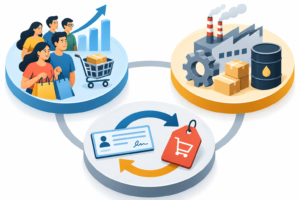
Built-in inflation is driven by expectations. When workers notice groceries and rent getting more expensive, they negotiate higher wages to maintain their standard of living. To pay those higher salaries, companies raise the prices of their products—prompting workers to demand even higher pay in a continuous loop known as the wage-price spiral.
- Modern Inflation Drivers: Money Supply, Climate, and Corporate Margins
- Monetary Expansion: When a central bank expands the money supply much faster than real economic output grows, currency loses value relative to physical goods.
- Climateflation: Extreme heatwaves, floods, and erratic monsoons increasingly disrupt crop yields, triggering sharp spikes in food inflation.
- Sellers’ Inflation (Greedflation): In industries dominated by a few large corporations, companies sometimes raise prices faster than their actual input costs rise, expanding profit margins while blaming general inflation.
Types of Inflation You Experience Every Day
By Speed and Severity
- Creeping Inflation (1%–3% annually): Slow, predictable price growth that encourages consumers to spend rather than delay purchases.
- Walking Inflation (3%–10% annually): Noticeable erosion of purchasing power that pressures household budgets and prompts central banks to tighten policy.
- Galloping Inflation (10%–50%+ annually): Rapid loss of currency value where wages fail to keep pace, destabilizing savings and business planning.
- Hyperinflation (50%+ per month): An out-of-control spiral—such as in Weimar Germany (1923), Zimbabwe (2008), or Venezuela (2018)—where money becomes virtually worthless overnight.
Headline Inflation vs. Core Inflation
- Headline Inflation measures the total price change across the entire consumer basket, including food and fuel.
- Core Inflation strips out volatile food and energy prices. Central banks rely on core inflation to see underlying, long-term price trends without being distracted by temporary weather or oil shocks.
Hidden Inflation Variants
- Shrinkflation: Companies keep the price tag the same while reducing the weight or quantity inside the package (e.g., a ₹20 bag of chips dropping from 50g to 42g).
- Skimpflation: Businesses maintain the same price while quietly downgrading ingredient quality, customer service, or product durability.
- Lifestyle Inflation: A personal finance trap where your spending rises automatically every time your income increases, preventing you from building wealth.
Why “Perceived Inflation” Feels Higher Than Official Numbers
Many households feel that real inflation is double what government statistics report. Research from central banks shows three psychological reasons for this gap:
- Frequency bias: You notice price hikes on items you buy every week (milk, vegetables, petrol) far more than items you buy rarely (laptops, TVs, air conditioners), which often fall in price or improve in quality.
- Loss aversion: Price increases stick in human memory much longer than stable or falling prices.
- Personal basket differences: Official CPI tracks an average household. If you commute long distances by car or rent in a high-demand metro city, your personal inflation rate will exceed the national headline figure.
Inflation vs. Deflation, Disinflation, and Stagflation
Understanding how inflation differs from related economic terms makes financial news much easier to follow:
| Economic Term | What It Means | Impact on Prices | Economic Effect |
| Inflation | General rise in prices over time. | Prices rise; money buys less. | Healthy when low (2%–4%); harmful when high. |
| Disinflation | A slowdown in the rate of inflation (e.g., falling from 7% to 4%). | Prices still rise, just more slowly. | Often signals that interest rate hikes are working. |
| Deflation | A sustained drop in the general price level (negative inflation). | Prices fall; money buys more. | Dangerous: consumers delay spending, business revenues drop, and unemployment rises. |
| Stagflation | High inflation combined with stagnant economic growth and high unemployment. | Prices rise rapidly while jobs shrink. | The hardest scenario for policymakers to fix (seen globally in the 1970s). |
Winners and Losers: Is Inflation Always Bad?
Economists generally view zero inflation or deflation as dangerous. If prices fall continuously, consumers postpone buying cars, homes, and appliances because they expect things to be cheaper next month—causing factories to shut down and layoffs to surge. That is why central banks like the US Federal Reserve target 2% inflation, while the Reserve Bank of India (RBI) targets 4% (within a 2%–6% tolerance band).
However, inflation redistributes wealth unevenly across society:
Who Benefits From Inflation?
- Fixed-Rate Borrowers: If you hold a long-term home loan at a fixed interest rate, inflation lets you repay the bank in future rupees or dollars that are worth less than when you borrowed them.
- Owners of Tangible Assets: Real estate, land, gold, and productive businesses often see their nominal values rise alongside general prices.
Who Gets Hurt by Inflation?
- Cash Savers: Money sitting in a low-interest savings account or physical cash loses real value every year.
- Fixed-Income Retirees & Pensioners: People living on fixed pensions or fixed-deposit interest without inflation adjustments see their standard of living shrink.
- Low-Income Households: Because lower-income families spend the highest percentage of their earnings on food, rent, and fuel, price spikes hit them first and hardest.
How Central Banks and Governments Control Inflation
When inflation climbs above comfort levels, policymakers use two main levers to cool down the economy:
- Monetary Policy (Central Banks): Institutions like the RBI, Federal Reserve, and European Central Bank raise benchmark interest rates (such as the Repo Rate or Fed Funds Rate). Higher rates make home loans, auto loans, and business credit more expensive, slowing down spending and bringing demand back in line with supply.
- Fiscal Policy (Governments): Governments can reduce public spending, raise taxes to absorb excess demand, cut import duties on scarce commodities (like edible oils or pulses), or release buffer food stocks to stabilize prices.
5 Practical Ways to Protect Your Savings From Inflation
To preserve your wealth, you must focus on your Real Return rather than your Nominal Return:
\(\text{Real\ Return}=\text{Investment\ Return\ (\%)}-\text{Inflation\ Rate\ (\%)}\)
If your bank fixed deposit pays 6.5% interest while inflation is 6%, your real return before taxes is just 0.5% (and negative after income tax). Consider these strategies to outpace inflation over time:
| Asset Class / Strategy | How It Protects Against Inflation | Risk & Liquidity Profile |
| 1. Diversified Equities / Index Funds | Strong companies pass rising input costs onto customers, allowing corporate earnings and stock prices to grow faster than inflation over 7+ years. | High short-term volatility; high liquidity. |
| 2. Inflation-Indexed Bonds | Government-backed securities (like US TIPS or inflation-linked bonds) adjust their principal or payout directly based on CPI readings. | Low default risk; moderate returns. |
| 3. Gold & Precious Metals | Acts as a historical store of value during currency depreciation and high geopolitical uncertainty. | Moderate volatility; generates no regular cash flow. |
| 4. Real Estate & REITs | Property values and rental yields tend to adjust upward with inflation over long horizons; REITs allow smaller, liquid investments. | High capital requirement (physical) or market risk (REITs). |
| 5. Upskilling & Income Growth | Your earning power is your strongest inflation hedge—negotiating raises or building high-demand skills keeps income ahead of living costs. | Requires time and effort; highest long-term payoff. |

Frequently Asked Questions (FAQs)
What is the simple meaning of inflation?
Inflation is the steady rise in the average price of everyday goods and services over time. As prices go up, the purchasing power of your money goes down, meaning ₹100 or $100 buys less today than it did in the past.
What causes inflation to go up?
Inflation rises due to three main factors: strong consumer demand outpacing supply (demand-pull), higher costs for raw materials, fuel, and shipping (cost-push), and rising wages pushing companies to charge more (built-in inflation).
How do you calculate the inflation rate?
Subtract last year’s Consumer Price Index (CPI) from this year’s CPI, divide that difference by last year’s CPI, and multiply by 100. For example, if CPI rises from 200 to 210, the inflation rate is (10 / 200) × 100 = 5%.
Why do central banks aim for 2% to 4% inflation instead of 0%?
A small, steady rate of inflation encourages people to spend and invest today rather than hoarding cash, prevents dangerous deflationary recessions, and gives central banks room to cut interest rates during economic downturns.