Monthly Grocery Budget in India (2026): Realistic Costs by Family Size, City & Diet
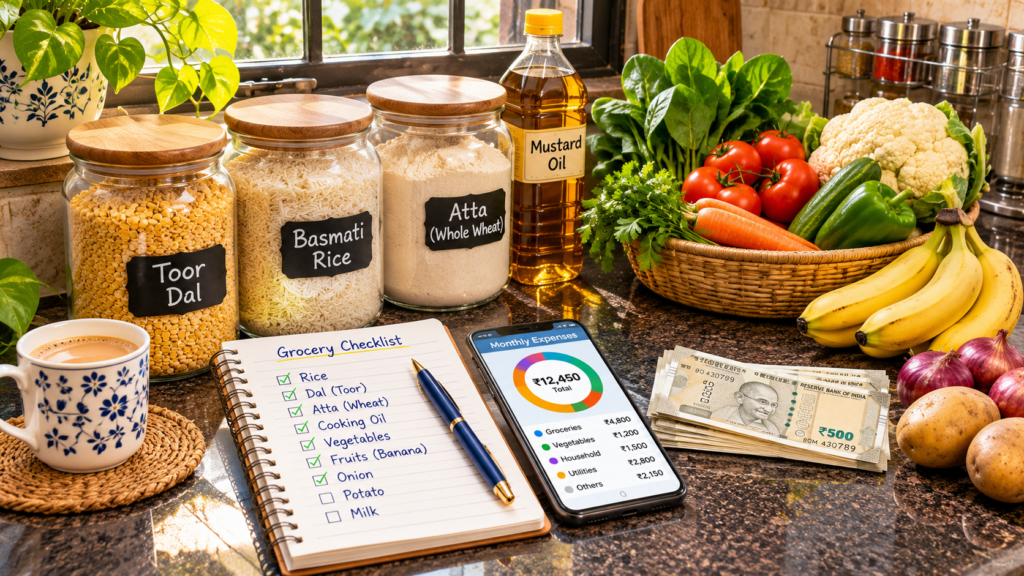
A typical monthly grocery budget in India ranges from ₹3,500 to ₹5,500 for a single person, ₹6,500 to ₹9,000 for a couple, and ₹10,500 to ₹15,500 for a family of four. As a general rule of thumb, Indian households should allocate 12% to 15% of their monthly take-home income toward core groceries, adjusting by 15%–20% depending on whether they live in a Tier-1 metro or a Tier-2 city.
Average Monthly Grocery Budget in India by Household Size
Grocery costs vary sharply based on where you live and what you eat. Tier-1 metros like Mumbai, Bengaluru, and Delhi NCR carry higher fresh produce, dairy, and delivery markups compared to Tier-2 and Tier-3 cities.
| Household Size | Diet Type | Tier-2 / Tier-3 Cities | Tier-1 Metros (Delhi, Bengaluru, Mumbai) |
| 1 Person (Bachelor / Student) | Vegetarian | ₹2,800 – ₹3,800 | ₹3,500 – ₹4,800 |
| 1 Person (Bachelor / Student) | Non-Vegetarian | ₹3,500 – ₹4,500 | ₹4,400 – ₹5,800 |
| 2 People (Couple / Flatmates) | Vegetarian | ₹5,200 – ₹6,800 | ₹6,500 – ₹8,200 |
| 2 People (Couple / Flatmates) | Non-Vegetarian | ₹6,200 – ₹7,800 | ₹7,800 – ₹9,500 |
| 4 People (Nuclear Family) | Vegetarian | ₹8,500 – ₹10,500 | ₹10,500 – ₹13,000 |
| 4 People (Nuclear Family) | Non-Vegetarian | ₹10,000 – ₹12,500 | ₹12,500 – ₹15,500 |
How Much Should You Spend Based on Your Salary?
If your food bill crosses 20%–25% of your take-home pay, the leak is rarely dal, rice, or atta—it is almost always frequent quick-commerce orders, packaged snacks, and eating out.
- ₹25,000 – ₹35,000 Monthly Income: Target ₹3,500 – ₹5,000 (14%–15%). Focus on bulk dry staples and seasonal local mandi produce.
- ₹50,000 – ₹75,000 Monthly Income: Target ₹7,000 – ₹10,500 (12%–14%). Comfortable margin for quality branded staples, daily dairy, and weekly protein.
- ₹1,00,000 – ₹1,50,000+ Monthly Income: Target ₹12,000 – ₹18,000 (10%–12%). Includes cold-pressed oils, organic produce, dry fruits, and specialty items without lifestyle creep.
Complete Indian Monthly Grocery List with 2026 Prices
Use this master itemized checklist to plan your monthly kitchen run. Estimates reflect standard mid-range Indian brands and 2026 retail averages across urban markets.
- Staples: Atta, Rice & Grains
North vs. South Indian Adjustment: North Indian households typically buy 10 kg atta and 4–5 kg rice, whereas South Indian households reverse this ratio (8–10 kg Sona Masoori/Idli rice and 2–3 kg atta). The total category cost remains nearly identical.
| Item | Qty (2 People) | Est. Cost (2 People) | Qty (4 People) | Est. Cost (4 People) |
| Whole Wheat Atta (Chakki) | 5 kg | ₹220 – ₹260 | 10 kg | ₹420 – ₹490 |
| Daily Rice (Sona Masoori / Kolam) | 4 kg | ₹240 – ₹300 | 8 kg | ₹480 – ₹600 |
| Basmati Rice | 1 kg | ₹110 – ₹140 | 2 kg | ₹220 – ₹280 |
| Poha / Suji / Daliya | 1.5 kg total | ₹90 – ₹120 | 2.5 kg total | ₹150 – ₹200 |
| Besan & Maida | 1 kg total | ₹90 – ₹110 | 1.5 kg total | ₹130 – ₹160 |
| Category Subtotal | — | ₹750 – ₹930 | — | ₹1,400 – ₹1,730 |
- Dals, Pulses & Protein
| Item | Qty (2 People) | Est. Cost (2 People) | Qty (4 People) | Est. Cost (4 People) |
| Toor / Arhar Dal | 1.5 kg | ₹225 – ₹260 | 2.5 kg | ₹375 – ₹430 |
| Moong Dal (Yellow / Green) | 1 kg | ₹130 – ₹160 | 1.5 kg | ₹195 – ₹240 |
| Chana & Masoor Dal | 1 kg total | ₹110 – ₹135 | 2 kg total | ₹220 – ₹270 |
| Rajma / Kabuli Chana / Kala Chana | 1 kg total | ₹130 – ₹160 | 1.5 kg total | ₹195 – ₹240 |
| Soya Chunks / Peanuts | 500 g | ₹70 – ₹90 | 1 kg | ₹140 – ₹180 |
| Eggs (Optional) | 30 units (1 tray) | ₹210 – ₹250 | 60 units (2 trays) | ₹420 – ₹500 |
| Chicken / Fish / Mutton (Optional) | 2.5 kg | ₹650 – ₹850 | 4 kg | ₹1,050 – ₹1,400 |
| Veg Subtotal | — | ₹665 – ₹805 | — | ₹1,125 – ₹1,360 |
| Non-Veg Subtotal | — | ₹1,525 – ₹1,905 | — | ₹2,595 – ₹3,260 |
- Cooking Oil & Ghee
| Item | Qty (2 People) | Est. Cost (2 People) | Qty (4 People) | Est. Cost (4 People) |
| Cooking Oil (Mustard / Sunflower / Groundnut) | 2.5 L | ₹375 – ₹460 | 5 L | ₹720 – ₹880 |
| Desi Cow Ghee | 500 ml | ₹310 – ₹370 | 1 L | ₹600 – ₹720 |
| Category Subtotal | — | ₹685 – ₹830 | — | ₹1,320 – ₹1,600 |
- Dairy Products
| Item | Qty (2 People) | Est. Cost (2 People) | Qty (4 People) | Est. Cost (4 People) |
| Fresh Milk (Toned / Full Cream) | 15–20 L (0.5 L/day) | ₹850 – ₹1,250 | 30 L (1 L/day) | ₹1,650 – ₹2,040 |
| Curd / Dahi | 2 kg (or homemade) | ₹150 – ₹190 | 4 kg | ₹300 – ₹380 |
| Paneer | 800 g | ₹320 – ₹380 | 1.5 kg | ₹600 – ₹720 |
| Butter / Cheese | 200 g | ₹110 – ₹140 | 400 g | ₹220 – ₹280 |
| Category Subtotal | — | ₹1,430 – ₹1,960 | — | ₹2,770 – ₹3,420 |
- Fresh Fruits & Vegetables
| Item | Qty (2 People) | Est. Cost (2 People) | Qty (4 People) | Est. Cost (4 People) |
| Base Aromatics (Onions, Potatoes, Tomatoes, Ginger, Garlic) | ~10 kg | ₹400 – ₹550 | ~18 kg | ₹700 – ₹950 |
| Seasonal Green Vegetables | ~10 kg | ₹550 – ₹750 | ~18 kg | ₹950 – ₹1,300 |
| Seasonal Fruits (Banana, Apple, Papaya, Citrus) | ~6 kg | ₹500 – ₹700 | ~10 kg | ₹850 – ₹1,150 |
| Category Subtotal | — | ₹1,450 – ₹2,000 | — | ₹2,500 – ₹3,400 |
- Spices, Tea, Coffee & Condiments
| Item | Qty (2 People) | Est. Cost (2 People) | Qty (4 People) | Est. Cost (4 People) |
| Core Masalas (Haldi, Mirch, Dhaniya, Jeera, Garam Masala) | Monthly top-up | ₹200 – ₹280 | Monthly top-up | ₹350 – ₹480 |
| Salt & Sugar / Jaggery | 2 kg total | ₹90 – ₹120 | 3.5 kg total | ₹150 – ₹200 |
| Tea Patti / Coffee | 350 g | ₹180 – ₹260 | 600 g | ₹300 – ₹450 |
| Sauces, Pickles & Dry Fruits | Basic pack | ₹150 – ₹250 | Family pack | ₹300 – ₹450 |
| Category Subtotal | — | ₹620 – ₹910 | — | ₹1,100 – ₹1,580 |
- Snacks, Beverages, Cleaning & Personal Care
| Item | Qty (2 People) | Est. Cost (2 People) | Qty (4 People) | Est. Cost (4 People) |
| Biscuits, Namkeen, Bread & Noodles | Light monthly stock | ₹300 – ₹450 | Family stock | ₹550 – ₹800 |
| Detergent, Dishwash, Floor & Toilet Cleaners | Monthly refill | ₹350 – ₹480 | Family refill | ₹550 – ₹750 |
| Soaps, Shampoo, Toothpaste & Toiletries | Monthly refill | ₹400 – ₹550 | Family refill | ₹650 – ₹900 |
| Category Subtotal | — | ₹1,050 – ₹1,480 | — | ₹1,750 – ₹2,450 |
Where Indian Grocery Budgets Leak: Quick-Commerce vs. Supermarket vs. Mandi
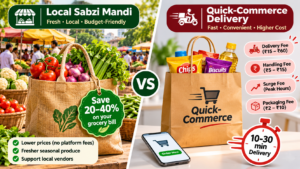
Buying the exact same monthly basket across different channels can swing your bill by ₹1,800 to ₹3,000 every month.
| Shopping Channel | Best Used For | Typical Price Markup / Discount | Hidden Budget Traps |
| Local Kirana & Sabzi Mandi | Fresh vegetables, fruits, loose dals, urgent staples | 10%–25% cheaper on produce than retail | No itemized digital tracking unless logged manually |
| Wholesale Supermarkets (DMart / Reliance Smart) | Monthly bulk atta (10 kg), 5 L oil jars, detergents, soaps | 8%–15% below MRP on bulk packs | Eye-level impulse aisles (biscuits, chocolates, frozen snacks) |
| Quick-Commerce (Blinkit / Zepto / Instamart) | Genuine emergencies (missing milk, lemons, medicines) | MRP + 15%–35% effective cost on fresh items | Handling fees, surge fees, minimum cart top-ups to get “free delivery” |
The 3-Bucket Method to Cut Your Grocery Bill by 15%–20%
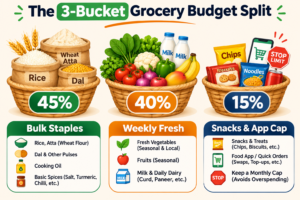
Instead of putting all ₹12,000 into one mental bucket—where early-month impulse buys leave you short by the 22nd—split your grocery budget into three strict channels:
- Bucket 1: Monthly Bulk Dry Rations (40%–45% of budget)
Buy atta, rice, dals, cooking oil, spices, and cleaning supplies once a month between the 1st and 5th using a written checklist. Buying 5 L oil pouches and 10 kg atta bags saves 10%–12% over small weekly packs. - Bucket 2: Twice-a-Week Fresh Produce & Protein (35%–40% of budget)
Visit your local sabzi mandi or trusted vendor every Sunday and Wednesday with a fixed weekly cash or dedicated UPI wallet limit (e.g., ₹600 per trip). Buying twice a week prevents refrigerator spoilage, which accounts for nearly 20% of urban Indian vegetable waste. - Bucket 3: Quick-Commerce & Snacks Cap (10%–15% of budget)
Cap instant delivery orders by order count rather than rupees (for example, maximum 2 app orders per month). Eliminating the “₹50 item + ₹250 impulse snacks to unlock free delivery” habit easily saves ₹1,000–₹1,500 a month.
Frequently Asked Questions (FAQs)
How much does a single person spend on groceries per month in India?
A single person cooking at home in India spends between ₹2,800 and ₹4,800 per month on basic vegetarian groceries, or ₹3,500 to ₹5,800 if including eggs, chicken, or fish. Relying on daily food delivery or quick-commerce snacks can easily push this past ₹8,000.
What is the average monthly grocery budget for a family of 4 in India?
In Tier-2 and Tier-3 cities, a family of four typically spends ₹8,500 to ₹12,500 per month. In Tier-1 metros like Mumbai, Bengaluru, and Delhi NCR, the same household typically spends ₹10,500 to ₹15,500 per month, depending on dairy consumption and non-vegetarian frequency.
What percentage of monthly income should go toward groceries?
Most financial planners recommend keeping core household groceries within 12% to 15% of monthly take-home income (or up to 18%–20% for lower-income households). If total food spending exceeds 25% of income, separating restaurant dining and app delivery from raw groceries will show where the excess spend is happening.
Is it cheaper to buy groceries weekly or monthly in India?
A hybrid schedule is cheapest. Buy non-perishable dry staples (atta, rice, dals, oil, soaps) monthly in bulk to get wholesale discounts, and buy vegetables, fruits, milk, and meat weekly or twice a week to avoid spoilage and overbuying.