Electricity Bill Calculator India (2026–27) — State-Wise & Appliance Estimator
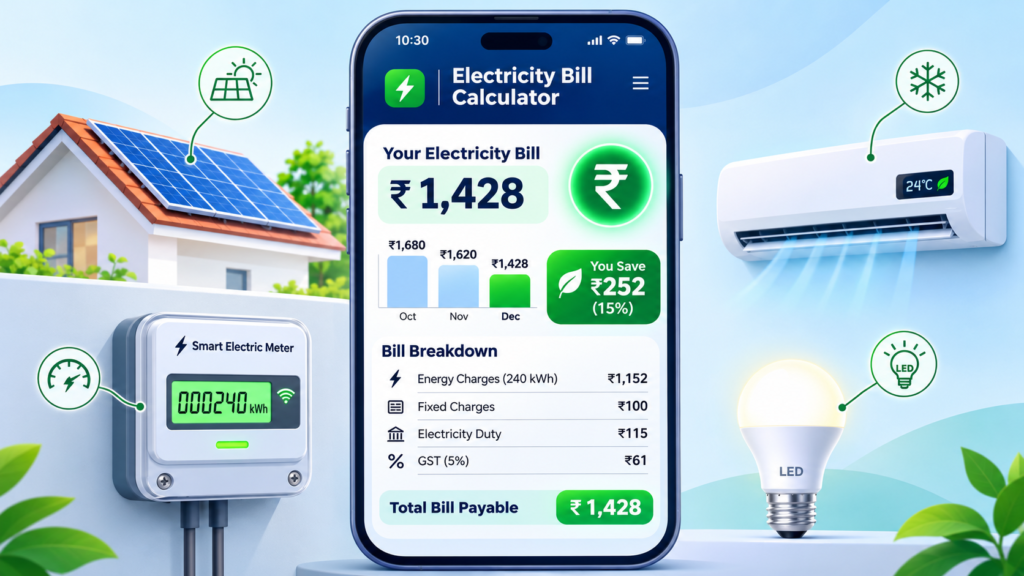
Whether your monthly power bill suddenly spiked without extra usage or you are trying to budget for a new air conditioner, calculating an Indian electricity bill manually can be confusing. Unlike flat-rate utilities abroad, Indian distribution companies (DISCOMs) use telescopic tariff slabs, load-based fixed charges, monthly fuel surcharges (FPPAS/FAC), and strict subsidy cliffs
Use the calculator above to get an itemized estimate for your state in seconds, or follow the exact formulas, state-wise tariff tables, and worked examples below to verify every rupee on your bill.
How Electricity Bill Calculation Works in India (The Master Formula)
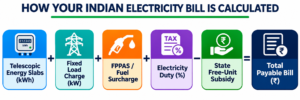
Every domestic electricity bill across India—whether from BSES/Tata Power (Delhi), UPPCL (UP), MSEDCL (Maharashtra), TANGEDCO (Tamil Nadu), or BESCOM (Karnataka)—is built from five core components:
\(\text{Total\ Bill}=(\text{Energy\ Charges}+\text{Fixed\ Charges}+\text{FPPAS/FAC}+\text{Electricity\ Duty})-\text{State\ Subsidy}\)
- Units Consumed (kWh)
One “unit” on your meter equals 1 kilowatt-hour (kWh)—the power used by a 1,000-watt appliance running for 1 hour.
- From Meter Readings: Current Reading – Previous Reading = Units Consumed
- From Appliances: \(\frac{\text{Watts} \times \text{Hours per Day} \times \text{Days}}{1,000} = \text{Units Consumed}\)
- Telescopic Slab Calculation
Most Indian states use telescopic billing. You do not pay the highest slab rate on all your units; each bracket of units is billed at its own progressive rate.
- Example: If you consume 250 units, your first 100 units might be billed at ₹3.00, the next 100 at ₹4.50, and only the remaining 50 units at ₹6.50.
- Fixed / Demand Charges (Sanctioned Load)
Even if your house is locked all month and you consume 0 units, you must pay a monthly fixed charge based on your Sanctioned Load (in kW) printed on your bill (typically 1 kW to 5 kW for Indian homes).
- FPPAS / FAC (Fuel & Power Purchase Adjustment Surcharge)
DISCOMs revise this percentage every month or quarter to recover fluctuating coal and power-purchase costs. If your unit consumption stayed identical to last month but your bill rose by 5%–15%, a monthly FPPAS/FAC revision is almost always the reason.
- Electricity Duty & State Subsidies
State governments levy a statutory Electricity Duty / Tax (typically 5% to 16%) on energy charges, and then deduct any applicable free-unit or slab subsidies.
State-Wise Domestic Electricity Tariff & Subsidy Comparison (2026–27)
Before entering your numbers, check how your state handles free-unit subsidies, billing cycles, and slab rates:
| State / UT | Major DISCOMs | Billing Cycle | Free Unit / Subsidy Scheme | Typical Domestic Slab Range (₹/unit) | Electricity Duty / Tax |
| Delhi | BRPL, BYPL, TPDDL | Monthly | 0–200 units free; 50% off (up to ₹800) for 201–400 units | ₹3.00 – ₹8.00 | 5% MCD Tax + 15% Surcharges |
| Uttar Pradesh | UPPCL (PVVNL, DVVNL, MVVCL, PuVVNL) | Monthly | Subsidised lifeline slab (up to 100 units, ≤1 kW) | ₹3.00 – ₹6.50 | 5% |
| Maharashtra | MSEDCL, Adani, Tata Power, BEST | Monthly | None (Concessional 0–100 unit slab) | ₹4.40 – ₹15.50+ | 16% (Residential) |
| Tamil Nadu | TANGEDCO (TNEB) | Bi-Monthly | First 100 units free (per 2-month cycle) | ₹0.00 – ₹11.00 | Included / Minimal |
| Karnataka | BESCOM, MESCOM, HESCOM, GESCOM | Monthly | Gruha Jyothi (Up to 200 units free based on average usage) | ₹4.75 – ₹7.00+ | 9% |
| Punjab | PSPCL | Bi-Monthly / Monthly | 300 units/month free (600 units bi-monthly) | ₹4.19 – ₹7.75 | 13%–15% |
| West Bengal | WBSEDCL, CESC | Quarterly / Monthly | Hasir Alo (75 units/quarter for lifeline consumers) | ₹5.04 – ₹8.99 | ~10% |
| Gujarat | UGVCL, DGVCL, MGVCL, PGVCL, Torrent | Bi-Monthly / Monthly | None (Low base slabs) | ₹3.05 – ₹5.20 | 15% (Urban) |
| Rajasthan | JVVNL, AVVNL, JdVVNL | Bi-Monthly | Mukhyamantri Nishulk Bijli Yojana (Up to 100 units/month) | ₹4.75 – ₹7.95 | ₹0.40/unit + Urban Cess |
| Kerala | KSEB | Bi-Monthly | Concessional non-telescopic/telescopic low-usage slabs | ₹3.25 – ₹8.80 | 10% |
Step-by-Step Worked Examples (How Your Real Bill Is Calculated)
Example 1: Standard Monthly Bill (250 Units, 3 kW Load — Delhi BRPL)
Suppose a household in Delhi uses 250 units in a month with a 3 kW sanctioned load:
- Energy Charges:
- First 200 units × ₹3.00 = ₹600.00
- Remaining 50 units × ₹4.50 = ₹225.00
- Subtotal Energy = ₹825.00
- Fixed Charge (3 kW × ₹50/kW): ₹150.00
- DERC Surcharges (8% Deficit + 7% Pension = 15% on ₹975): ₹146.25
- FPPAS (~17.94% on ₹975): ₹174.91
- Electricity Tax (5% on ₹825 energy): ₹41.25
- Delhi Govt Subsidy (50% of ₹825 energy): -₹412.50
- Final Payable Bill: ₹924.91 (Effective cost: ₹3.70/unit)
5 Hidden Billing Rules That Cause Sudden Bill Shocks in India
Most online calculators give inaccurate results because they ignore these five Indian regulatory rules:
- The “Subsidy Cliff” Trap (400 Units vs. 401 Units)
In subsidy states like Delhi, Punjab, and Karnataka, subsidies do not taper off gradually—they vanish completely if you cross the threshold by even 1 unit.
- In Delhi, a 400-unit bill receives an ₹800 subsidy (~₹1,518 total).
- A 401-unit bill loses the entire ₹800 subsidy (~₹2,277 total). Crossing by 1 single unit adds over ₹750 to your bill.
- Bi-Monthly Billing Cycles (60-Day Slab Doubling)
States like Tamil Nadu (TNEB), Kerala (KSEB), and Punjab (PSPCL) issue bills every two months (60 days). When you enter 600 units into a generic monthly calculator, it overestimates your bill because bi-monthly DISCOMs double the slab limits (e.g., 0–200 units free instead of 0–100). Always select Bi-Monthly in the calculator if your bill covers 60 days.
- Smart Meter Time-of-Day (ToD) Tariffs (2026–27 Rollout)
Under the Ministry of Power’s Time-of-Day (ToD) tariff rules, consumers with smart meters (starting with commercial/industrial and rolling out to high-load domestic users above 10 kW) face dynamic pricing:
- Solar Hours (9:00 AM – 4:00 PM): 10% to 20% discount on energy charges.
- Peak Evening Hours (6:00 PM – 10:00 PM): 10% to 20% surcharge on energy charges.
- Tip: Running washing machines, dishwashers, and EV chargers during afternoon solar hours directly lowers your effective per-unit rate.
- Excess Demand / Sanctioned Load Penalty (MDI)
If your sanctioned load is 2 kW, but you simultaneously run a 1.5-ton AC (1.6 kW), a geyser (2.0 kW), and a microwave (1.2 kW), your Maximum Demand Indicator (MDI) hits 4.8 kW. DISCOMs charge a 2x excess demand penalty on the extra kW and may automatically upgrade your sanctioned load (permanently increasing your monthly fixed charge).
- Tenant Sub-Meter Splitting on a Shared Meter
If a landlord and tenant share one main meter in a telescopic slab state, charging the tenant a flat rate (or splitting 50/50) often creates disputes:
- Fair Sub-Meter Formula: Divide the Total Main Bill Amount (₹) by the Total Main Meter Units (kWh) to find the Effective Blended Rate per Unit, then multiply by the tenant’s sub-meter units:
\(\text{Tenant\ Share\ (₹)}=\left(\frac{\text{Total\ Main\ Bill}}{\text{Total\ Main\ Units}}\right)\times \text{Tenant\ Sub-Meter\ Units}\)
Household Appliance Power Consumption Chart (India)
Want to know which appliance is pushing you into a higher tariff slab? Check typical monthly consumption for common Indian household appliances:
| Appliance | Typical Wattage | Daily Usage | Monthly Units (kWh) | Approx. Monthly Cost (at ₹6.50/unit) |
| 1.5-Ton 5-Star Inverter AC | 1,100 W (avg running) | 8 hours | ~264 units | ₹1,716 |
| 1.5-Ton 3-Star Non-Inverter AC | 1,600 W | 8 hours | ~384 units | ₹2,496 |
| Storage Water Geyser (15L) | 2,000 W | 1 hour | ~60 units | ₹390 |
| Double-Door Inverter Fridge (260L) | 150 W (cycles on/off) | 24 hours (~8h compressor) | ~36 units | ₹234 |
| Standard Ceiling Fan (Induction) | 75 W | 14 hours | ~31.5 units | ₹205 |
| BLDC Energy-Saving Ceiling Fan | 28 W | 14 hours | ~11.8 units | ₹77 |
| Front-Load Washing Machine | 500 W (cold wash) | 1 hour | ~15 units | ₹98 |
| 43-Inch LED Smart TV | 80 W | 5 hours | ~12 units | ₹78 |
| Electric Scooter Home Charger | 750 W | 3 hours | ~67.5 units | ₹439 |
Troubleshooting: “Why Did My Electricity Bill Jump This Month?”
| What You See on Your Bill | Likely Hidden Cause | How to Fix It |
| Units stayed the same, bill rose 10%–20% | Monthly FPPAS / FAC surcharge hike or state tariff revision. | Check the FPPAS % line item against last month’s bill. |
| Units rose by just 10–15 kWh, bill jumped ₹700+ | You crossed a Subsidy Cliff (e.g., 200 or 400 units in Delhi; 300 in Punjab). | Trim 15–20 units next month (set AC to 24°C–26°C) to drop back into the subsidy slab. |
| Bill shows “Provisional / Assessed” reading | Meter reader couldn’t access your meter; DISCOM billed an estimated average. | Submit a self-meter reading photo via your DISCOM app (BSES, UPPCL, Mahavitaran) for instant adjustment. |
| Fixed charges suddenly doubled | Your peak load exceeded your Sanctioned Load, triggering an auto-upgrade or MDI penalty. | Avoid running geyser + AC + induction stove simultaneously, or apply for a load revision if seasonal. |
Frequently Asked Questions (FAQs)
- How can I calculate my electricity bill from my meter reading?
Subtract your Previous Meter Reading from your Current Meter Reading (both in kWh) to find your total units consumed. Enter that unit count, your state/DISCOM, and your sanctioned load (in kW) into the calculator above to apply telescopic slab rates, fixed charges, FPPAS, and state subsidies.
- Why is my actual DISCOM bill slightly higher than online calculator estimates?
Online calculators compute base energy slabs, fixed charges, and standard duties. Your final bill may include monthly FPPAS/FAC variations, meter rent (₹10–₹50/month), arrears/adjustments, or security deposit interest adjustments specific to your Consumer Account (CA) number.
- Does installing rooftop solar make my electricity bill ₹0?
Under PM Surya Ghar: Muft Bijli Yojana, net metering deducts your solar export units from your grid import units, which can reduce your Energy Charges to ₹0. However, in most Indian states, you still pay the monthly Fixed Sanctioned Load Charge and minimal meter rent.
- How do I reduce my monthly electricity bill without replacing appliances?
- Set your AC temperature to 24°C or 25°C (each degree lower increases compressor power draw by ~6%).
- Switch off geysers immediately after heating water instead of leaving them on standby.
- Stay just below your state’s subsidy cutoff (e.g., 200 or 400 units in Delhi, 300 units in Punjab) to retain full government concessions.
- What is the difference between Sanctioned Load and Connected Load?
Connected Load is the combined wattage of all electrical appliances installed in your home. Sanctioned Load (in kW) is the maximum power limit officially approved by your DISCOM for your connection, which determines your monthly fixed charge.