What is Repo Rate? Meaning, Current RBI Rate (5.50%) & How It Impacts Your Loan EMI
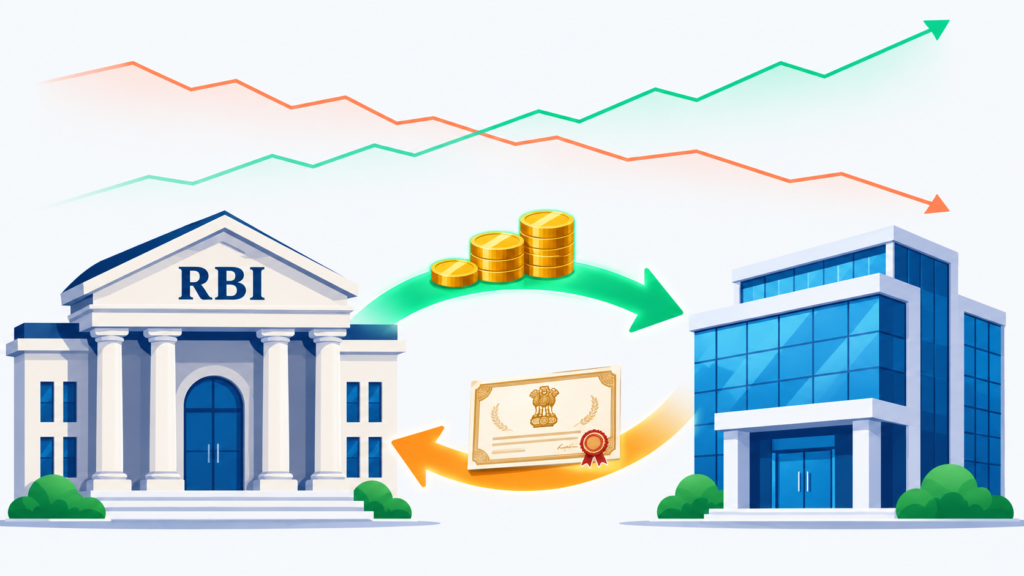
The repo rate (short for repurchase rate or repurchase agreement rate) is the interest rate at which the Reserve Bank of India (RBI) lends short-term funds to commercial banks against government securities as collateral. As of November 2026, the current RBI repo rate is 5.50%, following a 25-basis-point (0.25%) hike by the Monetary Policy Committee (MPC) on October 7, 2026.
Because most floating-rate home and business loans in India are directly benchmarked to this rate, any change in the repo rate directly alters your monthly EMI or total loan tenure.
Current RBI Policy Rates (November 2026)
To understand where the repo rate sits in India’s banking ecosystem, look at the RBI’s broader Liquidity Adjustment Facility (LAF) corridor:
- Policy Repo Rate (5.50%): The benchmark rate at which banks borrow short-term funds from the RBI against collateral.
- Standing Deposit Facility / SDF (5.25%): The floor of the policy corridor where banks park excess cash overnight without needing collateral.
- Marginal Standing Facility / MSF (5.75%): The ceiling rate for emergency overnight bank borrowing above standard limits.
- Bank Rate (5.75%): The penalty and long-term lending rate aligned with the MSF.
- Fixed Reverse Repo Rate (3.35%): The legacy rate for absorbing surplus liquidity against securities.
- CRR (3.00%) & SLR (18.00%): Mandatory cash and liquid asset reserves banks must maintain.
How Does the Repo Rate Work? (A Real-World Example)
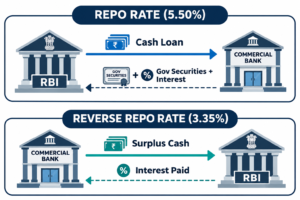
A repo transaction works like a secured short-term pawn agreement between a commercial bank and the central bank:
- Cash Shortage: Suppose a bank faces a temporary cash shortfall of ₹100 Crore to meet daily withdrawal and lending demands.
- Pledging Securities: The bank sells ₹100 Crore worth of approved Government Securities (G-Secs) to the RBI in exchange for immediate cash.
- Repurchase Promise: Both parties sign a binding agreement that the bank will buy back those exact securities on a fixed date (such as overnight or after 7–14 days) at a slightly higher price calculated at the 5.50% annual repo rate.
When the RBI wants to cool inflation, it raises the repo rate. Borrowing becomes costlier for banks, forcing them to raise loan interest rates, which slows down consumer spending and cools price growth. When economic growth slows, the RBI cuts the repo rate, making credit cheaper so businesses expand and households spend more.
Repo Rate vs. Reverse Repo, SDF, MSF & Bank Rate
Many borrowers confuse the RBI’s different policy tools. Each serves a distinct purpose inside the monetary system:
- Repo vs. Reverse Repo: Repo injects money into banks (RBI lends to banks), whereas Reverse Repo pulls excess cash out of banks (RBI borrows from banks).
- Repo vs. SDF (Standing Deposit Facility): Introduced as the active floor of the LAF corridor, SDF lets banks deposit surplus cash with the RBI at 5.25% without the RBI having to pledge government securities in return.
- Repo vs. MSF (Marginal Standing Facility): While regular repo borrowing uses surplus securities above the statutory limit, MSF allows banks to dip into their mandatory SLR quota for emergency overnight cash at a 25 bps penalty (5.75%).
- Repo vs. Bank Rate: Repo requires collateral and is used for short-term liquidity management, whereas the Bank Rate requires no collateral and applies to long-term advances and regulatory penalties.
How Repo Rate Affects Your Loan EMI (Rupee-by-Rupee Math)
Since October 2019, the RBI has mandated that all new floating-rate retail loans (such as home loans and MSME loans) be linked to an External Benchmark Lending Rate (EBLR)—most commonly the RBI repo rate.
Your final interest rate is calculated as:
\(\text{Your\ Loan\ Rate}=\text{RBI\ Repo\ Rate\ (5.50\%)}+\text{Bank\ Spread}+\text{Credit\ Risk\ Premium}\)
Real Impact: ₹50 Lakh Home Loan (20-Year Tenure)
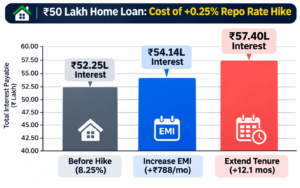
Imagine you hold a ₹50,00,000 floating-rate home loan for 20 years (240 months) at 8.25% p.a. Following a 0.25% (25 bps) repo rate hike that pushes your loan rate to 8.50% p.a., your lender will adjust your loan in one of two ways:
- Baseline (Before Hike at 8.25%): Your monthly EMI is ₹42,603, and your total interest payable over 20 years is ₹52,24,788.
- Option A — Bank Increases Your EMI (Tenure Stays 240 Months): Your EMI jumps by ₹788 per month to ₹43,391, adding ₹1,89,091 in extra interest over the full tenure.
- Option B — Bank Keeps EMI Same (₹42,603) & Extends Tenure: By default, most lenders keep your EMI unchanged and quietly extend your loan by 12.1 months (to 252.1 months), costing you ₹5,15,428 in extra interest—more than double the interest cost of an EMI hike.
(Tip: Per RBI guidelines on resetting floating-rate loans, lenders must communicate the impact of benchmark changes and give borrowers the option to switch between EMI enhancement, tenure elongation, or a combination of both).
Why Doesn’t Your EMI Change the Day After an RBI Announcement?
Even when the RBI changes the repo rate, your bank statement won’t reflect the change overnight. Two factors control the timing:
- Reset Dates on EBLR Loans: Banks reset external benchmark rates on a fixed schedule—typically once every quarter (3 months)—though some lenders reset monthly. Your EMI only changes on your specific reset date.
- Old MCLR or Base Rate Loans: If you took a home loan before October 2019 and never switched regimes, your loan may still be tied to MCLR (Marginal Cost of Funds-based Lending Rate). MCLR depends on the bank’s internal deposit costs and resets every 6 to 12 months, meaning rate cuts pass through much more slowly.
- Fixed-Rate Loans: Existing car loans, consumer durable loans, and fixed-rate personal loans are not affected by repo rate changes during their fixed tenure.
Impact on Fixed Deposits, Stock Market & Inflation
- Fixed Deposits (FDs) & Savings: When the repo rate rises, banks eventually raise FD interest rates to attract retail deposits—though deposit rate hikes usually lag behind loan rate hikes by several weeks.
- Stock Market: Higher repo rates increase corporate borrowing costs and reduce consumer discretionary spending, which often pressures rate-sensitive sectors like real estate, automobiles, and banking/NBFC stocks.
- Inflation Control: Under India’s flexible inflation-targeting framework, the six-member MPC adjusts the repo rate every two months to keep Consumer Price Index (CPI) inflation anchored near 4% (within a 2% to 6% tolerance band).
4 Smart Moves Borrowers Should Make After a Repo Rate Hike
If a rate hike pushes your loan interest higher, use these four steps to protect your finances:
- Choose an EMI Hike Over a Tenure Extension: If your budget allows paying ₹700–₹1,500 more per month, instruct your lender to raise your EMI rather than stretching your tenure—saving lakhs in compounding interest.
- Switch from MCLR/Base Rate to RLLR: Check your loan sanction letter or app. If you are still on an older MCLR benchmark, ask your bank to convert your loan to a Repo Linked Lending Rate (RLLR) for faster, transparent transmission.
- Make One Extra EMI Prepayment Each Year: Paying just one additional EMI annually—or prepaying 5% of your principal each year—can shave 3 to 4 years off a 20-year home loan and completely neutralize a 25–50 bps rate hike.
- Renegotiate Your Spread (or Consider a Balance Transfer): If your CIBIL score has improved above 750 or your salary has grown since you took the loan, ask your lender to lower your credit spread to match rates offered to new borrowers.
Historical RBI Repo Rate Cycles (2010–2026)
Tracking past RBI rate cycles shows how monetary policy responds to major economic shifts:
- 2011–2013 (High Inflation Era): Rates climbed as high as 8.50% to curb double-digit inflation.
- 2014–2019 (Gradual Easing): As inflation cooled under the new MPC framework, the repo rate eased steadily from 8.00% down to 5.15%.
- 2020–2021 (COVID-19 Pandemic): The RBI slashed the repo rate to a historic low of 4.00% to inject emergency liquidity and revive growth.
- 2022–2024 (Post-Pandemic Inflation Cycle): Between May 2022 and February 2023, the RBI hiked rates by 250 bps to 6.50%, holding steady through 2024.
- 2025–October 2026 (Easing & Recalibration): After cutting rates down to 5.25% across 2025, the MPC pivoted to calibrated tightening on October 7, 2026, raising the repo rate by 25 bps to 5.50%.
Frequently Asked Questions (FAQs)
- What is the full form of repo rate?
Repo rate stands for Repurchase Rate (or Repurchase Agreement Rate). It refers to the agreement by commercial banks to buy back pledged government securities from the RBI at a predetermined price and date.
- How often does the RBI review the repo rate?
The RBI’s Monetary Policy Committee (MPC) meets six times a year (roughly every two months) to review inflation, GDP growth, and liquidity before deciding whether to hike, cut, or hold the repo rate.
- Does the repo rate affect credit card interest rates?
Not directly. Credit card APRs (typically 36% to 45% per annum) are unsecured, fixed-structure rates set by card issuers and do not automatically move up or down with every 25 bps repo rate change.
- Can I switch my fixed-rate loan to a repo-linked floating loan?
Yes. Most banks and housing finance companies allow borrowers to convert from a fixed rate to a floating RLLR regime by paying a nominal one-time conversion fee (usually 0.50% plus GST of the outstanding principal).