CPI Full Form: Consumer Price Index Meaning, Formula, Types & Other Meanings (2026 Guide)
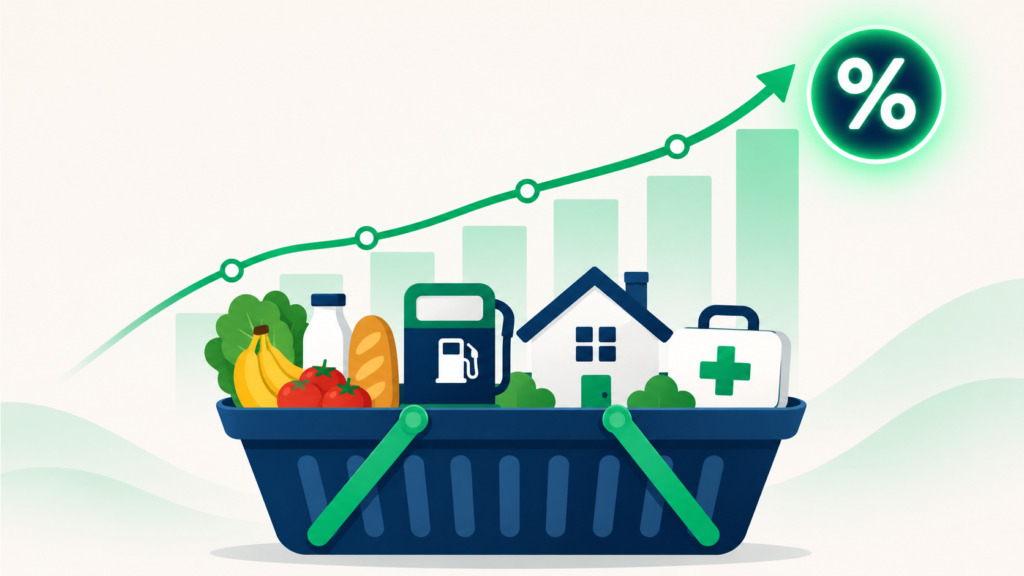
The full form of CPI is Consumer Price Index. In economics and finance, it is the primary metric used to measure retail inflation and changes in the cost of living by tracking monthly price movements in a fixed basket of everyday household goods and services.
Beyond economics, CPI also stands for the Communist Party of India (a major Indian political party), Cycles Per Instruction (in computer architecture), and Cost Per Impression (in digital marketing).
Quick Summary: CPI at a Glance
| Attribute | Key Details |
| Primary Full Form | Consumer Price Index |
| Hindi Full Form | उपभोक्ता मूल्य सूचकांक (Upbhokta Mulya Suchkanka) |
| What It Measures | Retail inflation and household purchasing power |
| Releasing Authority (India) | National Statistical Office (NSO), under MoSPI |
| Current Base Year (India) | 2024 = 100 (updated from 2012 = 100 in February 2026) |
| Release Frequency | Monthly (typically on the 12th of every month) |
| RBI Inflation Target | 4% (within a tolerance band of 2% to 6%) |
All Full Forms of CPI Across Different Fields
While retail inflation is the most common context, exam aspirants and professionals frequently encounter the acronym CPI in other domains:
- Economics & Finance — Consumer Price Index: Tracks average retail price changes paid by consumers for goods and services over time.
- Indian Politics — Communist Party of India: One of India’s oldest left-wing political parties, founded in 1925.
- Computer Science — Cycles Per Instruction: A hardware performance metric measuring the average number of clock cycles a CPU takes to execute a single instruction.
- Digital Marketing — Cost Per Impression / Cost Per Install: An advertising pricing model where advertisers pay per ad view (impression) or per app installation.
- Project Management — Cost Performance Index: An Earned Value Management (EVM) ratio used to measure a project’s cost efficiency (CPI = Earned Value / Actual Cost).
What is Consumer Price Index (CPI) in Economics?
The Consumer Price Index (CPI) measures how much more—or less—an average household has to spend today to buy the exact same basket of goods and services compared to a previous period.
Think of it like a standard monthly shopping cart filled with groceries, milk, cooking fuel, house rent, mobile data, doctor visits, and school fees.
- If that same cart costs ₹10,000 this year compared to ₹9,500 last year, the CPI rises, signaling inflation (a drop in your rupee’s purchasing power).
- If the total cost of the cart drops, the CPI falls, signaling deflation.
In India, the NSO collects monthly price quotes across rural markets and urban centers nationwide, while the BLS tracks similar consumer data in the United States.
How is CPI Calculated? (Formula + Worked Example)
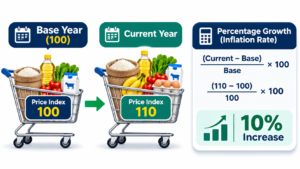
Calculating retail inflation happens in two steps: first finding the index number against a reference year, and then measuring the annual percentage change.
Step 1: CPI Index Formula
\(\text{CPI}=\left(\frac{\text{Basket\ Cost\ in\ Current\ Period}}{\text{Basket\ Cost\ in\ Base\ Year}}\right)\times 100\)
Step 2: Annual Inflation Rate Formula
\(\text{Inflation\ Rate\ (\%)}=\left(\frac{\text{Current\ Year\ CPI}-\text{Last\ Year\ CPI}}{\text{Last\ Year\ CPI}}\right)\times 100\)
Worked Numerical Example
Suppose a sample household basket cost ₹10,000 in the base year (Index = 100), rose to ₹10,600 last year, and reached ₹11,100 this year:
- Last Year’s CPI: \((10,600 / 10,000) \times 100 = \mathbf{106.0}\)
- Current Year’s CPI: \((11,100 / 10,000) \times 100 = \mathbf{111.0}\)
- Year-on-Year Inflation Rate: \(((111.0 – 106.0) / 106.0) \times 100 = \mathbf{4.72\%}\)
India’s Base Year Revision (2024 = 100)
To ensure the index reflects modern spending habits—such as digital services, transport, and healthcare—MoSPI shifted India’s CPI base year from 2012 to 2024 = 100 starting in February 2026, using updated household survey weights. Essential categories like food carry higher weightage than discretionary items because families spend a larger portion of their income on them.
Types of CPI in India & Globally
Because living costs differ between cities, villages, and income groups, statistical agencies publish multiple series:
- CPI (Combined): The headline national retail inflation figure covering both rural and urban households across India. The Reserve Bank of India (RBI) uses this number for monetary policy.
- CPI (Rural) & CPI (Urban): Separate indices tracking price pressures specifically in villages versus towns and cities.
- CPI-IW (Industrial Workers): Published by the Labour Bureau, this index is directly used to calculate Dearness Allowance (DA) hikes for government employees and pensioners.
- CPI-AL & CPI-RL: Track inflation for agricultural and rural labourers.
- Headline CPI vs. Core CPI: Headline CPI includes every item in the basket. Core CPI strips out food and fuel—whose prices swing wildly due to weather or global crude oil shocks—so policymakers can see steady, underlying inflation trends.
CPI vs. WPI vs. GDP Deflator
Economists use three main gauges to track price changes across different layers of the economy:
- CPI (Consumer Price Index): Measures retail prices paid directly by households for both goods and services; released monthly by NSO; used by the RBI to set interest rates.
- WPI (Wholesale Price Index): Tracks bulk factory-gate and mandi prices before goods reach retail shops; excludes services; released monthly by the Office of the Economic Adviser.
- GDP Deflator: Covers every domestically produced good and service across the entire economy (including government and corporate spending) without a fixed basket; released quarterly with GDP data.
How CPI Impacts Your Wallet, Loans, and Investments
- RBI Repo Rate & Loan EMIs: The RBI aims to keep retail inflation near 4%. When CPI climbs toward 6%, the Monetary Policy Committee often raises the repo rate to cool demand, making home, car, and personal loan EMIs costlier.
- Real Investment Returns: Your true wealth only grows if your returns beat CPI. If a bank fixed deposit pays 7.5% while retail inflation is 4.72%, your pre-tax real return is just 2.78% (and even lower after income tax).
- Salary & DA Adjustments: Central and state governments revise Dearness Allowance twice a year based on 12-month averages of CPI-IW, while private employers use CPI trends as a benchmark during annual appraisals.
- Currency & Stock Markets: Unexpected spikes in CPI data trigger immediate volatility in bond yields, equity sectors (like banking and FMCG), and forex pairs.
Limitations of CPI: Why Your Personal Inflation Feels Higher
- Average Basket Bias: CPI reflects an average national household. If you live in a metro city and spend heavily on private school fees, healthcare, or rent, your personal inflation rate will likely exceed the headline figure.
- Substitution Effect: When the price of one item (such as tomatoes or cooking oil) surges, families switch to cheaper alternatives, which a fixed basket takes time to capture.
- Excludes Asset Prices: CPI tracks everyday consumption, not rising real estate or stock market prices.
Frequently Asked Questions (FAQs)
- What is the full form of CPI in Hindi?
In Hindi, CPI stands for उपभोक्ता मूल्य सूचकांक (Upbhokta Mulya Suchkanka). - What is the current base year for CPI in India?
India uses 2024 = 100 as its CPI base year (revised from 2012 = 100 in February 2026). - Is high CPI good or bad for the stock market?
Moderately low and stable CPI (around 2%–4%) is positive for stocks because it supports consumer spending and low interest rates. Unexpectedly high CPI is usually negative in the short term, as it raises borrowing costs and squeezes corporate profit margins. - What is the difference between CPI and Cost Inflation Index (CII)?
CPI is published monthly by MoSPI to measure everyday retail inflation and cost of living. CII is notified annually by the Income Tax Department to adjust the purchase price of long-term capital assets (like property) for inflation when calculating capital gains tax. - Where can I check the latest official CPI data in India?
You can download the monthly CPI press releases and state-wise breakdowns directly from the official MoSPI portal.