GST Rates in India (2026 Updated): Complete 0%, 5%, 18% & 40% Slab List, HSN Codes & Business Guide
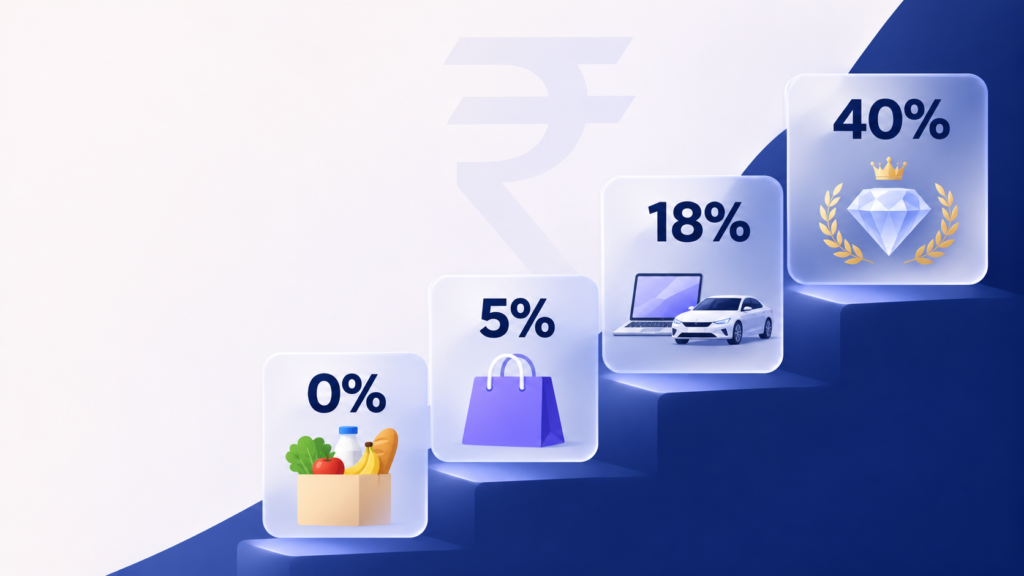
India’s active GST rates are structured into four primary slabs: 0% (Nil), 5%, 18%, and 40%, alongside special concessional rates of 0.25%, 1.5%, and 3% for precious metals and stones. Following the GST 2.0 reforms (effective September 22, 2025) and the February 1, 2026 tobacco and cess notifications, the older 12% and 28% slabs have been eliminated for general goods and services.
Whether you are updating your billing software, verifying an HSN/SAC code, or pricing inventory, this guide breaks down the current 2026 GST slabs by industry, explains how to handle rate-change invoicing traps, and gives you exact calculation formulas.
India’s Current GST Slab Structure (Post-GST 2.0)
Under the streamlined GST framework, central and state taxes split equally on intra-state sales (CGST + SGST/UTGST), while inter-state sales and imports attract Integrated GST (IGST) at the full combined rate.
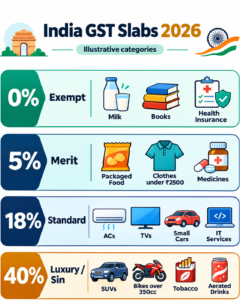
- 0% (Nil / Exempt): Covers unprocessed farm produce, unpacked grains, staple Indian breads, UHT milk, pre-packaged paneer, school stationery, individual health and life insurance policies, and over 30 life-saving drugs.
- 5% (Merit Slab): Applies to everyday household goods, packaged dairy (butter, ghee, cheese), packaged snacks, apparel and footwear priced up to ₹2,500, agricultural machinery, corrective spectacles, and standalone gym or salon services.
- 18% (Standard Slab): Serves as the default rate for most commercial services, IT/SaaS, consumer electronics (ACs, TVs, dishwashers), cement, compact cars, and motorcycles up to 350cc.
- 40% (Luxury & Demerit Slab): Consolidates the old 28% rate plus compensation cess into a single flat levy on large SUVs, bikes above 350cc, sugary aerated drinks, casinos, online money gaming, pan masala, and cigarettes.
- Special Jewellery Rates: Unworked diamonds attract 0.25%, cut and polished diamonds attract 1.5%, and gold, silver, and imitation jewellery attract 3% (with 5% applicable separately on jewellery making charges).
2026 GST Amendment Tracker: What Changed & When
Many online rate charts still confuse taxpayers by mixing outdated pre-reform rates with current rules. Here is the exact timeline of recent rate transitions:
- September 22, 2025 (GST 2.0 Rollout): Following the 56th GST Council decisions, the 12% and 28% tiers were phased out. Most daily essentials dropped from 12% or 18% down to 5% or 0%, while consumer durables and small vehicles moved from 28% down to 18%.
- February 1, 2026 (Tobacco & Sin Goods Shift): Cigarettes, chewing tobacco, and pan masala transitioned into the consolidated 40% slab alongside revised packaging-capacity rules, while bidis were rationalised to 18%.
- November 1, 2026 (Targeted Tariff Rationalisation): Select industrial and agricultural inputs—such as retreaded tractor tyres under HSN 4012—were adjusted to 5% to lower farm operating costs.
Note on Excluded Fuels & Alcohol: Petrol, diesel, aviation turbine fuel, natural gas, crude oil, and alcoholic liquor for human consumption remain outside GST and continue under state VAT and central excise duties.
Industry-Wise GST Rate Guide (With HSN & SAC Rules)
- Food, Dairy & Daily FMCG Essentials
Taxation on food depends heavily on processing and packaging:
- 0%: Fresh fruits, vegetables, eggs, unbranded milk/curd, unpacked grains, plus pre-packaged paneer (HSN 0406), UHT milk (HSN 0401), and Indian breads like roti and paratha.
- 5%: Packaged butter, ghee, and cheese (HSN 0405/0406), packaged namkeen and biscuits, sauces, jams, and personal care basics like soap, toothpaste, shampoo, and hair oil (HSN 3305, 3306, 3401).
- Apparel, Footwear & Retail (The ₹2,500 Rule)
- 5%: Ready-made garments (Chapters 61–62) and footwear (Chapter 64) with a sale value of ₹2,500 or less per piece/pair.
- 18%: Apparel and footwear priced above ₹2,500 per piece/pair.
- Electronics, Appliances & Automobiles
- 18%: Air conditioners (HSN 8415), dishwashers (HSN 8422), all television sizes (HSN 8528), mobile phones, commercial trucks, motorcycles up to 350cc (HSN 8711), and small cars (under 4,000 mm length; up to 1,200cc petrol/CNG or 1,500cc diesel).
- 40%: Motorcycles exceeding 350cc, large passenger cars and SUVs (exceeding 1,500cc and 4,000 mm length), yachts, and private aircraft.
- Healthcare, Education & Insurance
- 0%: Hospital and clinical treatments (excluding non-ICU rooms exceeding ₹5,000/day, which attract 5% without ITC), formal school/college education, notebooks, pencils, erasers, individual life/health insurance policies, and notified cancer/rare-disease drugs.
- 5%: Diagnostic kits, thermometers (HSN 9025), glucometers, corrective spectacles, and general non-exempt medicines.
- B2B Services, Restaurants & Real Estate (SAC)
- 5%: Standalone restaurants and outdoor catering (without ITC), economy air travel, and goods transport agencies (GTA) opting for 5% without ITC.
- 18%: IT/SaaS, legal, accounting, digital marketing, courier services, and restaurants inside specified high-tariff hotels (with ITC).
- Real Estate (Effective Rates): Affordable under-construction housing attracts 1.5% (0.75% CGST + 0.75% SGST), while non-affordable residential projects attract 7.5% (3.75% CGST + 3.75% SGST) after land-value abatement, subject to registered-supplier procurement thresholds.
How to Calculate GST & Handle Compliance Edge Cases
Forward & Reverse GST Calculation Formulas
- Adding GST (Exclusive Price):
GST Amount = (Base Price × GST %) ÷ 100
Example: On a ₹10,000 laptop service at 18%, GST is ₹1,800 (₹900 CGST + ₹900 SGST for intra-state), making the final bill ₹11,800. - Removing GST (Inclusive Price):
Base Price = Total Price × [100 ÷ (100 + GST %)]
Example: On a ₹1,050 inclusive FMCG bill at 5%, the base value is 1,050 × (100 ÷ 105) = ₹1,000, and GST is ₹50.
3 Critical Compliance Rules Competitors Miss
- Time of Supply Across Rate Changes (Section 14): If a rate changes between delivery, invoicing, and payment, check which two events happen on the same side of the effective date. If you deliver goods before a rate cut, but both the invoice and payment occur after the cut, the new lower rate applies.
- Bundled Products (Composite vs. Mixed Supply): A natural bundle sold together (like a smartphone shipped with a charger) is a composite supply taxed at the principal item’s rate (18%). An artificial combo of independent items sold for one price (like a festive hamper with 5% sweets and 18% chocolates) is a mixed supply taxed at the highest rate in the box (18%).
- Mandatory HSN Digits & ITC Reversal: Businesses with turnover up to ₹5 crore must report 4-digit HSN codes, while those above ₹5 crore must report 6-digit codes. If an item you hold in stock becomes 0% exempt (such as pre-packaged paneer), you must reverse the Input Tax Credit previously claimed on that unsold inventory under Section 18(4).
Frequently Asked Questions (FAQs)
Is there any 12% or 28% GST rate left in India in 2026?
No. Following the September 2025 GST 2.0 restructuring and the February 2026 tobacco updates, goods and services previously under 12% and 28% were redistributed across the 0%, 5%, 18%, and 40% slabs.
What is the GST rate on gold and jewellery making charges?
Gold bullion and jewellery attract 3% GST on the metal value, while making charges attract 5% GST when billed separately.
Are GST rates different when buying products online vs. offline?
No. The product’s HSN classification determines the GST rate regardless of whether you buy it in a store or on an e-commerce marketplace. However, e-commerce operators collect 1% TCS on net taxable supplies made through their platforms, and separate delivery or platform fees generally attract 18% GST.
How can I verify the exact GST rate for an HSN code?
You can cross-check official tariff schedules and rate notifications on the CBIC GST Rates portal or use the HSN search tool inside your GST portal dashboard before issuing invoices.