Government Subsidy Meaning: Types, Real Calculations, Active Schemes & Tax Rules
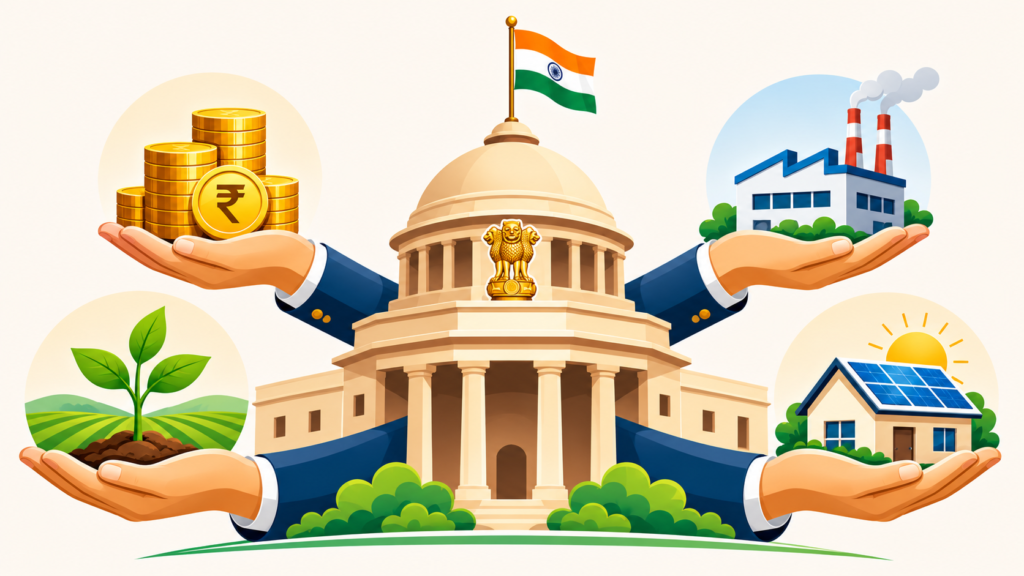
A government subsidy is direct or indirect financial assistance provided by the government to individuals, households, or businesses to reduce costs, encourage specific economic activities, or make essential goods affordable. Funded through taxpayer revenue, subsidies bridge the gap between high production costs and what consumers or small businesses can realistically afford.
Whether you are an economics student, a household consumer, or an MSME owner looking to reduce project costs, understanding how subsidies work—and how they differ from grants or tax breaks—helps you capture benefits without falling for outdated scheme information.
How Does a Government Subsidy Work? (With a Real Example)
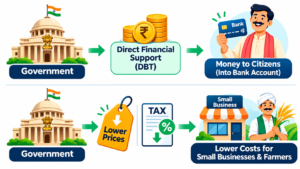
When a government introduces a subsidy, it absorbs a portion of the cost of a product, service, or business investment. This happens in two ways:
- Direct Benefit Transfer (DBT) / Cash Outlay: The buyer pays the full market price upfront, and the government deposits the subsidy directly into their Aadhaar-linked bank account (e.g., domestic LPG cylinders under PAHAL or PM Ujjwala Yojana).
- Upfront Price or Interest Reduction: The seller or lender lowers the price/interest rate at the point of purchase or loan sanction and claims reimbursement from the government later (e.g., subsidized urea fertilizers or interest subvention on loans).
Real-World Math: How a Business Loan Subsidy Saves Money
Most guides explain subsidies in theory, but here is how a Margin Money (Capital) Subsidy actually reduces your loan burden:
Suppose an entrepreneur sets up a rural manufacturing unit costing ₹10,00,000 under a government credit-linked scheme offering a 25% subsidy:
- Total Project Cost: ₹10,00,000
- Beneficiary’s Own Contribution (10%): ₹1,00,000
- Bank Loan Sanctioned (90%): ₹9,00,000
- Government Capital Subsidy (25%): ₹2,50,000 (kept in a subsidy reserve fund for a lock-in period of 3 years)
- Net Effective Loan You Repay Interest On: ₹6,50,000 (after the lock-in period adjusts the subsidy against your principal)
Subsidy vs. Grant vs. Interest Subvention: What’s the Difference?
| Feature | Government Subsidy | Government Grant | Interest Subvention |
| Core Meaning | Partial cost or price reduction on goods, inputs, or loans. | Lump-sum money awarded for a specific project, research, or startup. | A discount on the interest rate charged on a bank loan. |
| Repayment Required? | No (unless scheme conditions or lock-in rules are violated). | No. | No (you only repay the principal + reduced interest). |
| Typical Recipient | Farmers, low-income households, MSMEs, exporters. | Startups, NGOs, researchers, innovators. | Farmers (crop loans), MSMEs, affordable housing buyers. |
| Example | PM Surya Ghar rooftop solar subsidy. | Startup India Seed Fund grant. | Modified Interest Subvention Scheme (MISS) for Kisan Credit Cards. |
Major Types of Government Subsidies
- Direct vs. Indirect Subsidies
- Direct Subsidies: Involve actual cash transfers or bank deposits to beneficiaries. Examples include PM-KISAN income support, housing assistance under PMAY, and LPG DBT transfers.
- Indirect Subsidies: Provide financial relief without cash payouts. Examples include GST exemptions, customs duty waivers, accelerated depreciation for businesses, and free or below-cost electricity for agriculture.
- Production vs. Consumption Subsidies
- Production (Supply) Subsidies: Paid to producers or manufacturers to encourage domestic output and lower production costs. India’s Production Linked Incentive (PLI) schemes for electronics, pharma, and solar manufacturing are prime examples.
- Consumption (Demand) Subsidies: Designed to make basic necessities affordable for everyday citizens. Examples include subsidized rice and wheat under the National Food Security Act (NFSA) and lifeline electricity tariffs.
- Capital vs. Interest Subsidies (For Businesses & MSMEs)
- Capital Subsidy: Reimburses a percentage of fixed capital investment (machinery, plant, or equipment).
- Interest Subsidy: Lowers the effective borrowing rate on term loans or working capital loans for eligible sectors.
- Export Subsidies
- Financial incentives, duty remissions (such as RoDTEP), or low-cost export credit given to domestic exporters so their products remain price-competitive in global markets.
Active Government Subsidy Schemes in India (Updated List)
Unlike older lists that still mention discontinued schemes like CLCSS, these are active flagship programs:
| Scheme Name | Sector / Target Group | Key Subsidy Benefit |
| PMEGP (Prime Minister’s Employment Generation Programme) | New micro-enterprises & entrepreneurs | 15% to 35% margin money subsidy on project cost (up to ₹50 lakh for manufacturing). |
| PM Surya Ghar: Muft Bijli Yojana | Residential households | Direct rooftop solar subsidy of ₹30,000 (1 kW), ₹60,000 (2 kW), up to ₹78,000 (3 kW+). |
| PMAY (Pradhan Mantri Awas Yojana – Urban & Gramin) | Low- and middle-income homebuyers | Direct financial assistance for house construction or interest subsidy on home loans. |
| PM-KUSUM | Farmers & agricultural sector | 30% to 50% central/state subsidy on standalone solar agricultural pumps. |
| Agriculture Infrastructure Fund (AIF) | Agri-entrepreneurs, FPOs, startups | 3% interest subvention on loans up to ₹2 crore for post-harvest infrastructure. |
| Nutrient Based Subsidy (NBS) | Farmers | Subsidized fertilizers (DAP, MOP, NPK) sold at controlled MRP well below import/production cost. |
Are Government Subsidies Taxable in India?
Yes—tax treatment depends on the nature and purpose of the subsidy under Section 2(24)(xviii) of the Income Tax Act:
- Revenue Subsidies (Taxable): Subsidies received to support day-to-day operations, offset power/freight bills, or supplement trading receipts are treated as taxable business income.
- Capital Subsidies (Asset Cost Reduction): Subsidies granted specifically to acquire a depreciable asset (like plant or machinery) are generally deducted from the actual cost of the asset, which reduces the depreciation you can claim in future years rather than being taxed upfront as lump-sum income.
Economic Pros and Cons of Government Subsidies
Advantages
- Protects Vulnerable Households: Keeps food, cooking fuel, healthcare, and housing accessible during inflation.
- Corrects Market Failures: Encourages industries with positive externalities—such as renewable energy, electric vehicles, and public transport—that private markets might underinvest in.
- Boosts Domestic Manufacturing & Jobs: Helps emerging domestic industries compete against cheaper imports.
Drawbacks
- Fiscal Deficit Pressure: Large subsidy bills consume taxpayer money that could otherwise fund long-term infrastructure, schools, or hospitals.
- Market Distortion & Overuse: Artificially cheap inputs (such as free power or heavily subsidized urea) can lead to groundwater depletion, soil degradation, and inefficient resource use.
- Leakage & Dependency: Poorly targeted subsidies sometimes benefit wealthier groups or make industries reliant on state support to survive.
Step-by-Step: How to Apply for a Government Subsidy
- Verify Scheme Eligibility: Check official portals (such as JanSamarth, udyamregistration.gov.in, or the respective ministry portal) to confirm whether your business category, turnover, or income qualifies.
- Register Before Buying or Starting: Most capital and credit-linked subsidies require online application approval before purchasing machinery or disbursing the loan.
- Prepare Core Documents: Keep Aadhaar, PAN, Udyam Registration (for MSMEs), Detailed Project Report (DPR), bank statements, and vendor quotations ready.
- Apply via Official Portal / Lending Bank: Submit your application on the unified government portal (like JanSamarth for credit-linked schemes) and select your preferred bank branch.
- Inspection & Disbursement: After loan sanction and asset verification/geo-tagging, the nodal agency releases the subsidy directly to your bank account or subsidy reserve fund.
Frequently Asked Questions (FAQs)
- What is a government subsidy in simple words?
It is financial help from the government—given as cash, a discount, or a tax break—to lower the cost of essential goods for citizens or reduce operating/setup costs for businesses. - Who pays for government subsidies?
Subsidies are funded through the government’s budget, which comes primarily from direct and indirect taxes paid by citizens and businesses. - Can I get a subsidy after taking a business loan?
Usually, no. Most credit-linked subsidy schemes require you to apply through the official portal before the loan is sanctioned and disbursed. - What is the difference between a direct and indirect subsidy?
A direct subsidy puts money straight into the recipient’s bank account (like an LPG or PM-KISAN transfer), while an indirect subsidy lowers costs without cash payments (like tax exemptions or subsidized electricity tariffs).