MRP Full Form: Meaning, Rules, Calculation & Other Full Forms
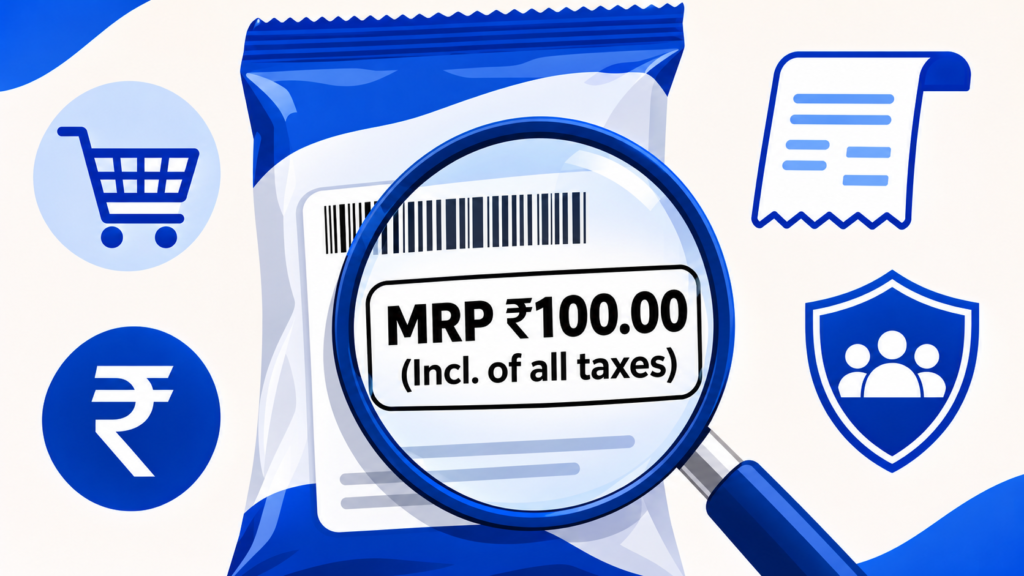
The full form of MRP is Maximum Retail Price. In India, MRP is the highest price printed on a pre-packaged product that a retailer can legally charge a consumer, inclusive of all taxes (such as GST). While sellers are free to offer discounts and sell below MRP, charging even a single rupee above it is a punishable offence under Indian law.
Depending on the industry, MRP also stands for Material Requirements Planning in manufacturing and Magnetic Resonance Pancreatography in medical science.
MRP Full Form Across Different Fields
Because “MRP” is used across retail, business management, and healthcare, knowing the exact context prevents confusion:
| Field / Context | MRP Full Form | Brief Meaning |
| Retail & Commerce (India) | Maximum Retail Price | The highest tax-inclusive price a seller can charge for a packaged product. |
| Manufacturing & Supply Chain | Material Requirements Planning | A production planning and inventory control system used to manage manufacturing processes. |
| Medical & Diagnostics | Magnetic Resonance Pancreatography | A specialized MRI imaging technique used to examine the pancreatic ducts. |
| Biochemistry / Oncology | Multidrug Resistance-Related Protein | A group of proteins that transport substances out of cells, often studied in cancer research. |
| Hindi | मैक्सिमम रिटेल प्राइस (अधिकतम खुदरा मूल्य) | किसी भी पैकेटबंद उत्पाद के लिए ग्राहक से वसूली जाने वाली अधिकतम कानूनी कीमत। |
What is Maximum Retail Price (MRP)?
Maximum Retail Price (MRP) is a consumer-protection pricing system mandated in India. Before a pre-packaged item reaches a store shelf, the manufacturer or importer calculates all production, distribution, and tax costs and prints the final ceiling price directly on the packaging alongside the phrase “Inclusive of all taxes.”
Unlike countries such as the United States or the United Kingdom—where brands only suggest a price and stores set their own final rates—India legally enforces MRP so buyers are not overcharged in remote areas, tourist hubs, or during high demand.
Who Decides the MRP of a Product?
The manufacturer, packer, or importer decides the MRP—not the Indian government (except for certain essential medicines regulated by the National Pharmaceutical Pricing Authority, NPPA). Brands set the MRP based on market competition, production expenses, and desired profit margins.
How is MRP Calculated? (With Practical Example)
Manufacturers use a pricing waterfall to arrive at the final MRP printed on the box:
\text{MRP} = \text{Manufacturing Cost} + \text{Packaging} + \text{Distributor & Retailer Margins} + \text{Logistics/Marketing} + \text{GST}
Example: How a ₹100 MRP Item is Priced
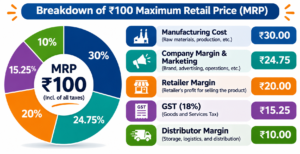
Suppose a company manufactures a bottle of shampoo with an MRP of ₹100 (subject to 18% GST):
- Base Manufacturing & Packaging Cost: ₹30.00
- Company Overhead, Marketing & Brand Margin: ₹24.75
- Distributor & Wholesaler Margin (~10%): ₹10.00
- Retailer Margin (~20%): ₹20.00
- GST (18% on base value): ₹15.25
- Final Printed MRP: ₹100.00
Note: Even if a product moves through extra middlemen, the retailer cannot pass extra transport costs onto the customer beyond ₹100.
MRP vs. MOP vs. SRP vs. Marked Price
Retailers, students, and e-commerce sellers often confuse MRP with other pricing terms. Here is how they differ:
| Feature | MRP (Maximum Retail Price) | MOP (Market Operating Price) | SRP / MSRP (Suggested Retail Price) | Marked Price (List Price) |
| Who Sets It? | Manufacturer / Importer | Brand / Manufacturer | Manufacturer | Seller / Manufacturer |
| Legal Status in India | Legally binding ceiling | Contractual floor (not a law) | Non-binding advice | Reference price for discounts |
| Printed on Pack? | Yes (Mandatory) | No (Internal trade rule) | Optional (Used outside India) | Yes (On price tags/catalogs) |
| Can Seller Charge Less? | Yes (Discounts allowed) | No (Breaches brand policy) | Yes | Yes |
| Can Seller Charge More? | No (Illegal) | Yes (Up to MRP) | Yes (Up to MRP) | Not above MRP |
| Includes GST? | Yes | Usually excluded | Varies by country | Varies |
MRP Rules & Laws in India (Legal Metrology Act)
In India, MRP is governed by Section 36 of the Legal Metrology Act, 2009 and the Legal Metrology (Packaged Commodities) Rules, 2011. Every consumer and seller should know these six rules:
- No Extra “Cooling Charges”: Shopkeepers cannot charge ₹2 or ₹5 extra over the MRP for chilling cold drinks, milk, or bottled water. Cooling is part of standard retail storage, not a separate service.
- No Extra GST at Billing: Because MRP is inclusive of all taxes, adding GST on top of the MRP at the cash counter is illegal.
- No Price Stickers Over Old MRPs: Retailers and distributors cannot paste a new price sticker over a lower printed MRP to profit from price hikes on old stock.
- E-Commerce & Quick Commerce Compliance: Under the Consumer Protection (E-Commerce) Rules, 2020, platforms like Amazon, Flipkart, Blinkit, and Zepto must clearly display the MRP, expiry date, and country of origin on product listings.
- Dual MRP Exception (Rule 18): A brand can print different MRPs on identical products only if one pack is clearly marked for institutional/bulk use (e.g., airlines or hotels) and the other for general retail sale.
- Hotels, Restaurants & Cinemas: Per Supreme Court rulings, sit-down hotels and restaurants that provide ambience, seating, and table service are not strictly bound by the Legal Metrology Act when serving items on their premises. However, over-the-counter retail stalls selling packaged goods without table service must follow MRP.
How to File a Complaint If Charged Above MRP
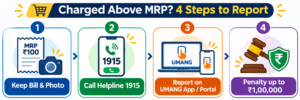
If a shopkeeper or delivery platform charges you more than the printed MRP, follow these four steps to report it:
- Collect Proof: Ask for a printed bill, tax invoice, or UPI payment receipt showing the item name and the overcharged amount. Take a clear photo of the product’s printed MRP.
- Call the National Consumer Helpline (NCH): Dial 1915 or 1800-11-4000 (toll-free, 8:00 AM to 8:00 PM) to register a formal grievance.
- File Online or via App: Submit your receipt and product photo on the official portal (consumerhelpline.gov.in), via SMS to 8130009809, or through the UMANG mobile app.
- State Legal Metrology Department: You can also escalate the complaint to your state’s Controller of Legal Metrology.
Penalties for Selling Above MRP
Under Section 36 of the Legal Metrology Act, 2009, violating MRP rules carries strict penalties:
- First Offence: Fine up to ₹25,000.
- Second Offence: Fine up to ₹50,000.
- Subsequent Offences: Fine up to ₹1,00,000, imprisonment up to 1 year, or both.
Advantages and Disadvantages of MRP
Advantages
- Protects Consumers: Prevents price gouging and black-marketing during shortages or peak seasons.
- Price Transparency: Buyers know the exact maximum cost upfront without calculating hidden taxes.
- Uniformity Nationwide: Ensures a packaged biscuit or soap costs no more in a remote village than in a metro city.
Disadvantages
- High Baseline Pricing: Manufacturers often inflate the MRP to cover maximum state transport costs and heavy retailer discounts, meaning buyers who don’t negotiate overpay.
- Squeezes Rural Retailers: Small shopkeepers in hilly or remote areas absorb higher transport costs because they cannot legally raise prices above MRP.
- Anti-Competitive Floor: Large brands sometimes set high MRPs to offer fake “50% Off” sales, misleading shoppers about true market value.
What is MRP in Manufacturing? (Material Requirements Planning)
In business studies, operations, and supply chain management, MRP stands for Material Requirements Planning. It is a software-based inventory and production planning system that helps factories ensure raw materials are available for production without overstocking.
A manufacturing MRP system answers three questions—what is needed, how much is needed, and when it is needed—using three core inputs:
- Master Production Schedule (MPS): Lists which finished goods need to be produced and their delivery deadlines.
- Bill of Materials (BOM): A complete recipe or list of every raw material, component, and sub-assembly required to build one unit of the product.
- Inventory Status File: Tracks current stock levels in the warehouse and raw materials already on order.
Frequently Asked Questions (FAQs)
- Is GST included in MRP?
Yes. Under Indian law, the MRP printed on any pre-packaged product is inclusive of all taxes, including GST. A seller cannot add GST separately on your bill above the MRP.
- Can a shopkeeper sell a product below MRP?
Yes. MRP is only the maximum ceiling price. Retailers are completely free to sell products below MRP by offering discounts, festive deals, or loyalty prices.
- Is MRP valid outside India?
No. India (along with a few neighboring countries like Bangladesh and Sri Lanka) legally enforces MRP. Most other countries use MSRP (Manufacturer’s Suggested Retail Price) or RRP (Recommended Retail Price), which are non-binding guidelines.
- Can a retailer charge extra for carry bags or cooling?
No retailer can add cooling charges to an MRP item. Regarding carry bags, consumer courts have ruled that stores cannot charge customers for carry bags that carry the store’s own brand logo/advertisement, though plain bags may be charged if disclosed clearly beforehand.
- What is the difference between MRP and Marked Price?
In mathematics and commerce exams, Marked Price (List Price) is the tag price set by a seller before offering a discount. In real-world Indian retail, MRP is the statutory legal maximum price printed by the manufacturer that includes all taxes.