
Income Tax Slabs for FY 2026-27 (Tax Year 2026-27): Complete Guide to New & Old Regimes
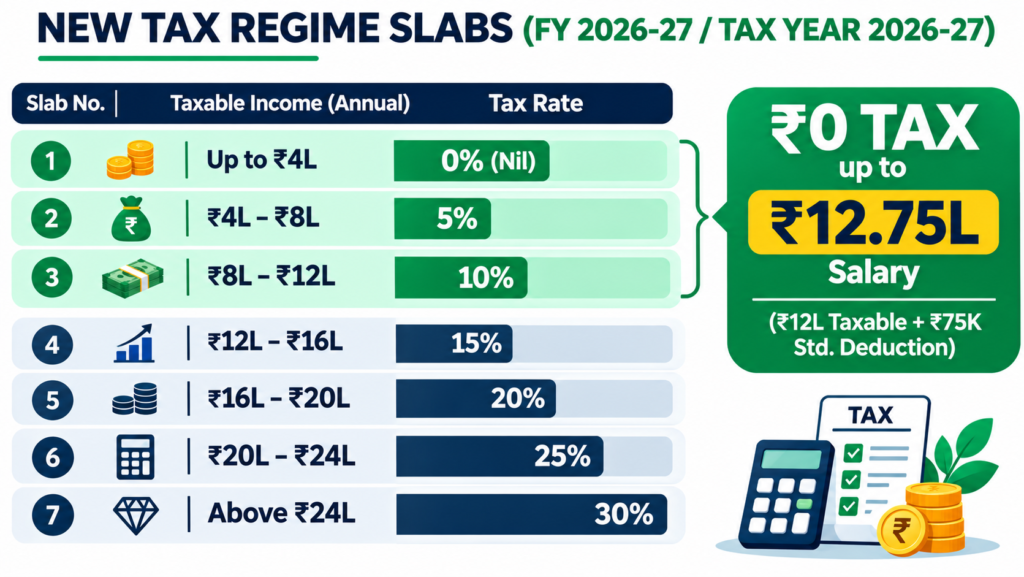
For Financial Year 2026–27 (now officially termed Tax Year 2026–27 under the Income-tax Act, 2025), individual income tax slabs under the New Tax Regime range from Nil up to ₹4 lakh to 30% above ₹24 lakh, with an enhanced rebate making regular slab income up to ₹12 lakh (or ₹12.75 lakh for salaried employees) completely tax-free.
While Budget 2026 kept slab rates unchanged from the previous year, the rollout of the Income-tax Act, 2025 on April 1, 2026, introduced new terminology and compliance rules that every taxpayer needs to know before choosing a tax regime.
Quick Summary: Key Tax Highlights for FY 2026-27
- Default Regime: The New Tax Regime remains the default option for individuals, HUFs, and AOPs.
- Zero-Tax Threshold: Eligible resident individuals pay ₹0 tax on taxable slab income up to ₹12,00,000 (up to ₹12,75,000 gross salary after the ₹75,000 standard deduction).
- New Terminology: “Previous Year” and “Assessment Year” are replaced by a unified “Tax Year 2026-27” for income earned between April 1, 2026, and March 31, 2027.
- Old Regime Status: Still active for taxpayers who actively opt out of the default regime and have high deductions (HRA, 80C, 80D, home loan interest).
- New Tax Regime Slabs for FY 2026-27 (Default)
Under the New Tax Regime, the same slab rates apply to all individuals regardless of age (including senior citizens and NRIs):
| Annual Taxable Income | Income Tax Rate | Tax Payable on Slab |
| Up to ₹4,00,000 | Nil | ₹0 |
| ₹4,00,001 – ₹8,00,000 | 5% | ₹20,000 |
| ₹8,00,001 – ₹12,00,000 | 10% | ₹40,000 |
| ₹12,00,001 – ₹16,00,000 | 15% | ₹60,000 |
| ₹16,00,001 – ₹20,00,000 | 20% | ₹80,000 |
| ₹20,00,001 – ₹24,00,000 | 25% | ₹1,00,000 |
| Above ₹24,00,000 | 30% | 30% of amount above ₹24L |
Note: A 4% Health & Education Cess applies to the final tax amount (plus surcharge, if taxable income exceeds ₹50 lakh).
How Zero Tax Up to ₹12.75 Lakh Works
- Standard Deduction: Salaried employees and pensioners get a flat ₹75,000 deduction, bringing a ₹12,75,000 gross salary down to ₹12,00,000 in taxable income.
- Slab Tax Calculation: On ₹12,00,000, slab tax comes to ₹60,000 (₹0 on first ₹4L + ₹20,000 on ₹4L–₹8L + ₹40,000 on ₹8L–₹12L).
- Full Tax Rebate: Resident individuals with taxable income up to ₹12,00,000 receive a rebate of up to ₹60,000, reducing net tax to ₹0.
- The ₹12 Lakh Rebate Cliff & Marginal Relief (Crucial Rule)
If your taxable income crosses ₹12,00,000 even by a small margin, you lose the ₹60,000 rebate. However, Marginal Relief protects you from paying more extra tax than the extra income you earned above ₹12 lakh.
- Example (Taxable Income = ₹12,20,000):
- Normal Slab Tax: ₹60,000 (up to ₹12L) + ₹3,000 (15% on ₹20,000) = ₹63,000.
- Income Exceeding ₹12L: ₹20,000.
- Marginal Relief Benefit: Since slab tax (₹63,000) exceeds the extra income (₹20,000), your base tax is capped at ₹20,000 (saving you ₹43,000 before 4% cess).
- Breakeven Cutoff: Marginal relief stops around ₹12,70,588 of taxable income, after which standard slab rates apply fully.
Watch Out for the Capital Gains Trap: The ₹60,000 rebate applies only to income taxed at normal slab rates. If you earn ₹11 lakh in salary and ₹1.5 lakh in short-term or long-term equity capital gains, you will still pay special-rate tax on the capital gains.
- Old Tax Regime Slabs for FY 2026-27 (Optional)
If you opt out of the New Tax Regime, your tax-free exemption limit depends on your age and residency status:
| Annual Taxable Income | Below 60 Years & All NRIs | Resident Senior Citizens (60–79 Yrs) | Resident Super Seniors (80+ Yrs) |
| Up to ₹2,50,000 | Nil | Nil | Nil |
| ₹2,50,001 – ₹3,00,000 | 5% | Nil | Nil |
| ₹3,00,001 – ₹5,00,000 | 5% | 5% | Nil |
| ₹5,00,001 – ₹10,00,000 | 20% | 20% | 20% |
| Above ₹10,00,000 | 30% | 30% | 30% |
- Standard Deduction (Old Regime): ₹50,000 for salaried employees/pensioners.
- Tax Rebate (Old Regime): Up to ₹12,500 for resident individuals with taxable income up to ₹5,00,000.
- Old vs. New Regime: Exact Breakeven Deduction Table
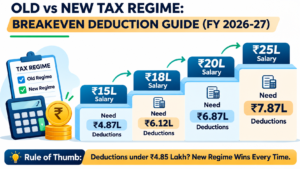
Most taxpayers wonder how many deductions they need for the Old Regime to beat the New Regime. Assuming a salaried individual below 60 (already factoring in ₹75,000 standard deduction in New vs. ₹50,000 in Old):
| Gross Salary | Tax in New Regime (No extra deductions) | Extra Deductions Needed in Old Regime (HRA + 80C + 80D + Home Loan) to Break Even |
| ₹12,00,000 | ₹0 | New Regime always wins (Old requires ₹7,00,000+ deductions to reach ₹0 tax) |
| ₹15,00,000 | ₹97,500 | ₹4,87,500 |
| ₹18,00,000 | ₹1,56,000 | ₹6,12,500 |
| ₹20,00,000 | ₹1,92,400 | ₹6,87,500 |
| ₹25,00,000 | ₹3,21,100 | ₹7,87,500 |
Rule of Thumb: If your total deductions (excluding standard deduction) are less than ₹4.85 lakh, the New Tax Regime saves more tax at every income level.
- Allowed Deductions & Regime Switching Rules
What Can You Claim Under Each Regime?
- New Tax Regime:
- Standard Deduction of ₹75,000 (salaried/pensioners).
- Employer’s contribution to NPS up to 14% of basic salary + DA (for both private and government employees).
- Interest on home loan for let-out (rented) property (up to taxable rental income; loss cannot be set off against salary).
- Agniveer Corpus Fund contributions.
- Old Tax Regime:
- Standard Deduction of ₹50,000.
- Investments & Insurance: Up to ₹1.5 lakh (EPF, PPF, ELSS, life insurance, home loan principal) + ₹50,000 self-NPS + ₹25,000–₹1,00,000 health insurance.
- Exemptions & Housing: HRA, LTA, and up to ₹2,00,000 interest on a self-occupied home loan.
How to Switch Between Regimes
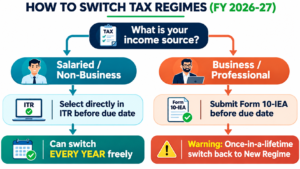
- Salaried / Non-Business Taxpayers: You can switch between the New and Old regimes every year directly when filing your ITR on or before the due date.
- Business / Professional Income: You must submit Form 10-IEA before the ITR due date to opt out of the New Regime. Once you opt out and later switch back to the New Regime, you cannot re-enter the Old Regime in future years (once-in-a-lifetime switch).
- Surcharge Rates & Marginal Relief Above ₹50 Lakh
For high-income earners, surcharge applies on the income tax amount as follows:
| Net Taxable Income | New Tax Regime Surcharge | Old Tax Regime Surcharge |
| Up to ₹50 Lakh | Nil | Nil |
| ₹50 Lakh – ₹1 Crore | 10% | 10% |
| ₹1 Crore – ₹2 Crore | 15% | 15% |
| ₹2 Crore – ₹5 Crore | 25% | 25% |
| Above ₹5 Crore | 25% (Capped) | 37% |
Note: Surcharge on dividends and capital gains (STCG/LTCG on listed equities) is capped at 15% under both regimes. Marginal relief ensures that crossing ₹50L, ₹1Cr, ₹2Cr, or ₹5Cr never increases your tax by more than the extra income earned above that threshold.
Frequently Asked Questions (FAQs)
- Is there a separate income tax slab for women in FY 2026-27?
No. Income tax slabs in India are identical for men and women under both the New and Old tax regimes. - Can NRIs claim the ₹12 lakh tax rebate or senior citizen exemption limits?
No. Both the Section 87A tax rebate (₹60,000 in New / ₹12,500 in Old) and the higher basic exemption limits for senior citizens (₹3 lakh / ₹5 lakh in Old Regime) are available only to Resident Individuals. - What is “Tax Year 2026-27” vs “AY 2027-28”?
Under the Income-tax Act, 2025 (effective April 1, 2026), India eliminated the confusing dual system of “Previous Year” and “Assessment Year.” Income earned from April 1, 2026, to March 31, 2027, is simply referred to as Tax Year 2026-27.