15+ Real-World Supply and Demand Examples (Everyday, Business & Exam Guide)

Every time you pay extra for a cab during a sudden downpour or snag a 50% discount on a winter jacket in March, you are experiencing the law of supply and demand in action.
In economics, supply is how much of a good or service producers are willing and able to sell at different prices, while demand is how much buyers are willing and able to purchase. When these two forces balance out, the market settles at an equilibrium price—where there is neither a shortage nor leftover stock.
Whether you are an economics student preparing for exams, a business owner pricing a product, or simply curious about how markets move, this guide breaks down 15+ real-world supply and demand examples, complete with numerical tables, curve-shift rules, and classic exceptions.
Quick Summary: How Supply & Demand Shifts Affect Prices

Before diving into detailed scenarios, here is a quick cheat sheet showing how changes in supply or demand impact inventory and market prices:
| Market Scenario | What Happens to Inventory? | Price Effect | Real-World Example |
| Demand Increases (Supply constant) | Shortage (Buyers outnumber goods) | Prices Rise | Cab surge pricing during heavy rain |
| Demand Decreases (Supply constant) | Surplus (Unsold stock builds up) | Prices Fall | Air conditioners discounted in winter |
| Supply Increases (Demand constant) | Surplus (More goods than buyers) | Prices Fall | Bumper wheat or mango harvest |
| Supply Decreases (Demand constant) | Shortage (Fewer goods available) | Prices Rise | Monsoon floods damaging tomato crops |
Everyday Life Supply and Demand Examples

- Ride-Hailing Surge Pricing (High Demand + Fixed Short-Term Supply)
On a dry afternoon, cab fares between central hubs stay steady because the number of active drivers matches rider requests. When heavy monsoon rain hits, thousands of commuters open ride-hailing apps at the exact same moment. Because the number of cars on the road cannot instantly double, demand surges while short-term supply remains fixed. Dynamic pricing raises fares to encourage more drivers to log on and ration rides to those willing to pay more.
- Monsoon Vegetable Price Spikes (Supply Shock)
Kitchen staples like tomatoes and onions have inelastic demand—households still buy them even when prices climb. When unseasonal rain or floods destroy standing crops, the supply reaching wholesale mandis drops overnight. With steady daily demand chasing a sharply smaller supply, retail prices can triple within a week until fresh harvests restore supply.
- End-of-Season Clothing Sales (Excess Supply / Surplus)
Fashion retailers stock up on heavy woolens and jackets ahead of winter. Once February and March arrive, temperatures rise and shopper demand drops sharply. Left with excess inventory taking up warehouse space, brands run “Flat 50% Off” clearance sales, lowering prices to clear the surplus and bring quantity demanded back in line with remaining stock.
- Airline Tickets & Hotel Bookings (Seasonal Demand Shifts)
A flight on a Tuesday morning in August costs a fraction of the exact same seat during the Diwali or Christmas holiday rush. Airlines operate a fixed number of seats on each route. During peak travel seasons, surging passenger demand pushes ticket prices toward their upper tier; during off-peak weeks, airlines drop fares to avoid flying half-empty planes.
Business, Tech & Global Market Examples
- Concert Tickets & Secondary Resale Markets (Fixed Supply)
When a major artist announces a stadium tour, venue capacity is strictly capped—say, 40,000 seats. If 300,000 fans try to buy tickets at launch, demand vastly exceeds supply. Primary tickets sell out in minutes, and a secondary resale market emerges where ticket holders list seats at multiples of the face value. Conversely, if a show fails to sell out close to the date, resellers cut prices below face value to recover costs.
- AI Chips & High-Performance GPUs (Demand Outpacing Production)
As global tech firms race to train generative AI models, orders for specialized data-center GPUs have skyrocketed. Because semiconductor fabrication plants take years and billions of dollars to build, supply cannot expand quickly enough to match the sudden demand wave. The result is multi-month waitlists, higher hardware prices, and soaring margins for chipmakers.
- Electric Vehicles & Battery Metals (Long-Term Supply Response)
When electric vehicle (EV) adoption accelerated globally, demand for battery-grade lithium and cobalt surged, driving raw material prices to record highs. In line with the law of supply, those higher prices signaled huge profit potential—prompting mining companies to open new projects and expand extraction. Over time, that newly added supply helped cool down raw lithium prices.
- Stock Market Share Prices (Double-Auction Demand)
Stock exchanges operate as real-time supply and demand engines. If a company announces unexpectedly strong quarterly profits, institutional and retail investors rush to buy shares while existing shareholders hold back. Because buy orders outnumber sell orders at the current price, the stock price climbs until enough sellers step in to match buyer demand.
Worked Numerical Example: Finding Equilibrium Price
To see how supply and demand settle on a single market price, imagine a specialty bakery selling artisan sourdough loaves in a neighborhood market:
| Price per Loaf (₹) | Quantity Demanded (\(Q_{d}\)) | Quantity Supplied (\(Q_{s}\)) | Market Condition | Pressure on Price |
| ₹100 | 120 loaves | 40 loaves | Shortage (80 loaves short) | Upward (Buyers bid prices up) |
| ₹150 | 100 loaves | 60 loaves | Shortage (40 loaves short) | Upward |
| ₹200 | 80 loaves | 80 loaves | Equilibrium (\(Q_d = Q_s\)) | Neutral (Stable Price) |
| ₹250 | 60 loaves | 100 loaves | Surplus (40 loaves unsold) | Downward |
| ₹300 | 40 loaves | 120 loaves | Surplus (80 loaves unsold) | Downward (Bakery discounts stock) |
- Below Equilibrium (₹100–₹150): Cheap prices attract many buyers, but the bakery cannot profitably bake enough loaves. Long queues and empty shelves push prices upward.
- Above Equilibrium (₹250–₹300): High prices encourage the bakery to bake 120 loaves, but most customers walk away. Leftover stale bread forces the bakery to cut prices.
- At Equilibrium (₹200): The bakery bakes 80 loaves, and customers buy all 80 loaves. The market clears cleanly.
Advanced Examples for Economics Students
- Movement Along the Curve vs. Shift of the Curve
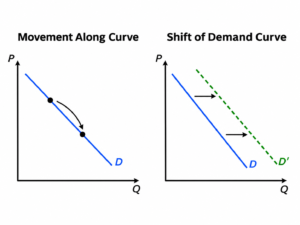
- Movement Along the Demand Curve: A café raises its cold brew price from ₹180 to ₹240 due to higher coffee bean costs. Fewer customers order it. Price changed, so you move along the existing demand curve.
- Shift of the Demand Curve: A viral medical study shows cold brew improves focus, and temperatures hit a record heatwave. Even at ₹240, far more customers buy it. A non-price factor (preferences and weather) shifted the entire demand curve to the right.
- Simultaneous Double-Shift Example (Print Newspapers)
What happens when both supply and demand move at once? Consider traditional print newspapers:
- Supply Decreases: Rising newsprint paper and ink costs make printing more expensive, shifting the supply curve left (pushing prices up, lowering quantity).
- Demand Decreases: Readers switch to free digital news apps, shifting the demand curve left (pushing prices down, lowering quantity).
Combined Outcome: Equilibrium quantity definitely falls because both shifts reduce sales. However, the net effect on price is indeterminate—it rises only if the supply drop is larger than the demand drop, and falls if the demand drop dominates.
- Giffen Goods Example (Exception to the Law of Demand)
A Giffen good is a rare staple inferior good with no close substitutes where demand actually rises when its price increases. For example, if the price of basic rice or coarse grain rises sharply for low-income households, they can no longer afford costlier items like meat, dairy, or vegetables. To meet their daily calorie needs, they end up buying more rice despite its higher price—producing an upward-sloping demand curve.
- Veblen Goods Example (Luxury Status Exception)
A Veblen good defies the law of demand because high price itself creates exclusivity and social status. Luxury mechanical watches (such as limited-edition Rolex or Patek Philippe models) and designer handbags often see stronger buyer desire after price hikes, because the steep price tag signals wealth and scarcity.
- Joint Demand & Derived Demand Examples
- Joint Demand (Complements): Products used together, such as cars and fuel or printers and ink cartridges. If fuel prices drop significantly, demand for SUVs and road travel tends to rise alongside it.
- Derived Demand: Demand for an input driven by demand for a final product. When residential housing construction booms, it automatically creates derived demand for cement, steel, bricks, and construction labor.
Government Intervention Examples (Price Ceilings & Floors)
Markets do not always operate freely. Governments frequently step in with legal price limits:
- Price Ceiling Example (Rent Control & Essential Medicines)
A price ceiling is a legal maximum price set below the natural equilibrium price to keep essentials affordable. For instance, strict urban rent-control caps or price caps on life-saving drugs make housing or medicine cheaper for current buyers, but discourage landlords from renting out apartments or manufacturers from increasing output—resulting in chronic shortages and waiting lists.
- Price Floor Example (Minimum Wage & Agricultural MSP)
A price floor is a legal minimum price set above equilibrium to protect producers or workers:
- Minimum Support Price (MSP): Guaranteeing farmers a minimum procurement price above market equilibrium encourages high crop output, often creating government grain surpluses.
- Minimum Wage Laws: Setting an hourly wage floor above the equilibrium wage for entry-level labor raises worker income per hour, though businesses may hire fewer workers if labor costs exceed productivity.
Frequently Asked Questions
What are 5 simple examples of supply and demand?
- Rainy-day cab surge pricing (demand spikes, supply fixed -> higher fares).
- Off-season winter clothing discounts (demand drops, supply high -> lower prices).
- Monsoon tomato/onion price hikes (crop supply drops, demand steady -> prices spike).
- Sold-out concert tickets (fixed stadium seats, huge fan demand -> high resale prices).
- Bumper mango harvests (high summer supply -> prices drop in local markets).
What happens when both supply and demand increase?
When both supply and demand increase simultaneously, the equilibrium quantity definitely rises because more goods are being produced and bought. However, the equilibrium price can rise, fall, or stay the same depending on whether demand grows faster than supply (prices rise) or supply grows faster than demand (prices fall).
Why does demand stay high for some goods even when prices rise?
Goods that are daily necessities with few close substitutes—such as petrol, electricity, insulin, or basic groceries—have inelastic demand. Consumers cannot easily stop buying them in the short term, so quantity demanded barely budges even when prices climb.